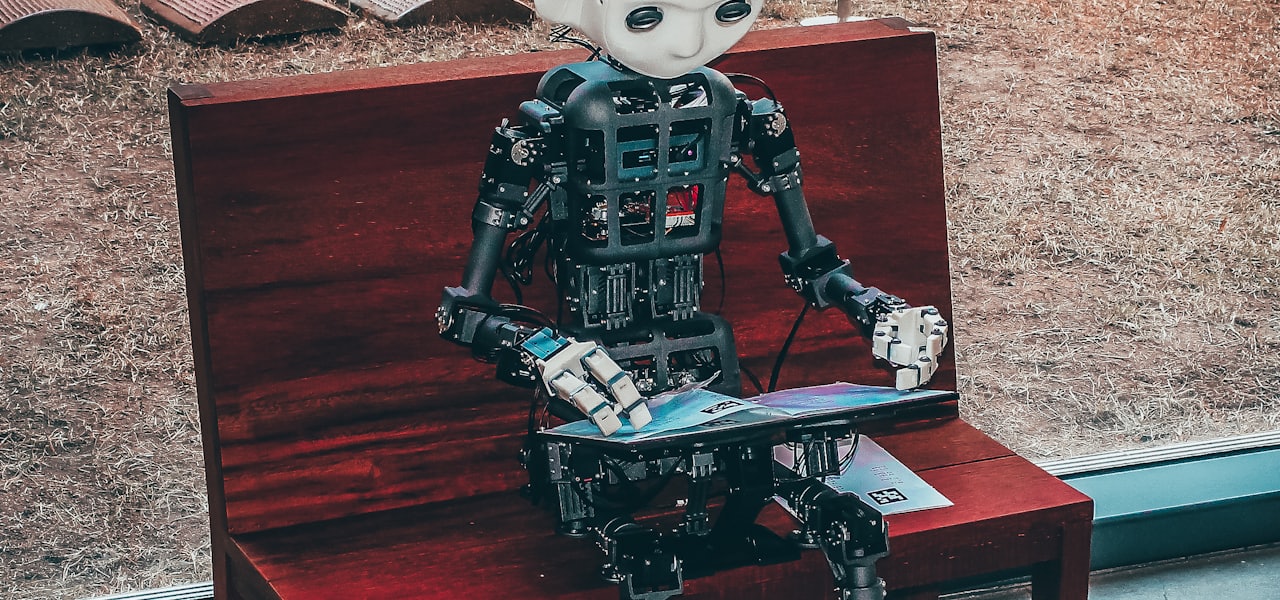
Racter is an artificial intelligence program that generates English language prose at random. It was published by Mindscape for IBM PC compatibles in 1984, then for the Apple II, Mac, and Amiga. An expanded version of the software, not the one released through Mindscape, was used to generate the text for the published book The Policeman's Beard Is Half Constructed. == History == Racter, short for raconteur, was written by William Chamberlain and Thomas Etter. Racter's initial creation was the short story Soft Ions, which appeared in the October 1981 issue of Omni (magazine). The publication's editors bought the story in January 1980, before it had even been written. In exchange for the rights, the editors offered financial support to Chamberlain and Etter so the two could refine Racter. In 1983, Racter produced a book called The Policeman's Beard Is Half Constructed (ISBN 0-446-38051-2). The program originally was written for an OSI which only supported file names at most six characters long, causing the name to be shorted to Racter and it was later adapted to run on a CP/M machine where it was written in "compiled ASIC on a Z80 microcomputer with 64K of RAM." This version, the program that allegedly wrote the book, was not released to the general public. The sophistication claimed for the program was likely exaggerated, as could be seen by investigation of the template system of text generation. In 1984, Mindscape released an interactive version of Racter, developed by Inrac Corporation, for IBM PC compatibles, and it was ported to the Apple II, Mac, and Amiga. The published Racter was similar to a chatterbot. The BASIC program that was released by Mindscape was far less sophisticated than anything that could have written the fairly sophisticated prose of The Policeman's Beard. The commercial version of Racter could be likened to a computerized version of Mad Libs, the game in which you fill in the blanks in advance and then plug them into a text template to produce a surrealistic tale. The commercial program attempted to parse text inputs, identifying significant nouns and verbs, which it would then regurgitate to create "conversations", plugging the input from the user into phrase templates which it then combined, along with modules that conjugated English verbs. By contrast, the text in The Policeman's Beard, apart from being edited from a large amount of output, would have been the product of Chamberlain's own specialized templates and modules, which were not included in the commercial release of the program. == Reception == The Boston Phoenix called the story Soft Ions "schematic nonsense. But the scheme is obvious enough and the nonsense accessible enough to an attentive reader that one can almost believe Chamberlain when he predicts that before long Racter will be ready to write for the pulp-reading public." PC Magazine described some of Policeman's Beard's scenes as "surprising for their frankness" and "reflective". It concluded that the book was "whimsical and wise and sometimes fun". Computer Gaming World described Racter as "a diversion into another dimension that might best be seen before paying the price of a ticket. (Try before you buy!)" A 1985 review of the program in The New York Times notes that, "As computers move ever closer to artificial intelligence, Racter is on the edge of artificial insanity." It also states that Racter's "always-changing sentences are grammatically correct, often funny and, for a computer, sometimes profound." The article includes examples showing interaction with Racter, most often Racter asking the user questions. == Reviews == Jeux & Stratégie #47
Cognitive philology
Cognitive philology is the science that studies written and oral texts as the product of human mental processes. Studies in cognitive philology compare documentary evidence emerging from textual investigations with results of experimental research, especially in the fields of cognitive and ecological psychology, neurosciences and artificial intelligence. "The point is not the text, but the mind that made it". Cognitive Philology aims to foster communication between literary, textual, philological disciplines on the one hand and researches across the whole range of the cognitive, evolutionary, ecological and human sciences on the other. Cognitive philology: investigates transmission of oral and written text, and categorization processes which lead to classification of knowledge, mostly relying on the information theory; studies how narratives emerge in so called natural conversation and selective process which lead to the rise of literary standards for storytelling, mostly relying on embodied semantics; explores the evolutive and evolutionary role played by rhythm and metre in human ontogenetic and phylogenetic development and the pertinence of the semantic association during processing of cognitive maps; Provides the scientific ground for multimedia critical editions of literary texts. Among the founding thinkers and noteworthy scholars devoted to such investigations are: Alan Richardson: Studies Theory of Mind in early-modern and contemporary literature. Anatole Pierre Fuksas Benoît de Cornulier David Herman: Professor of English at North Carolina State University and an adjunct professor of linguistics at Duke University. He is the author of "Universal Grammar and Narrative Form" and the editor of "Narratologies: New Perspectives on Narrative Analysis". Domenico Fiormonte François Recanati Gilles Fauconnier, a professor in Cognitive science at the University of California, San Diego. He was one of the founders of cognitive linguistics in the 1970s through his work on pragmatic scales and mental spaces. His research explores the areas of conceptual integration and compressions of conceptual mappings in terms of the emergent structure in language. Julián Santano Moreno Luca Nobile Manfred Jahn in Germany Mark Turner Paolo Canettieri
Pol.is
Polis (or Pol.is) is wiki survey software designed for large group collaborations. As a civic technology, Polis allows people to share their opinions and ideas, and its algorithm is intended to elevate ideas that can facilitate better decision-making, especially when there are lots of participants. Polis has been credited for assisting the passage of legislation in Taiwan. Pol.is has been used by governments in the United States, Canada, Singapore, Philippines, Finland, Spain and elsewhere. == History == Pol.is was founded by Colin Megill, Christopher Small, and Michael Bjorkegren after the Occupy Wall Street and Arab Spring movements. In Taiwan, pol.is has been "one of the key parts" of vTaiwan's suite of open-source tools for its citizen engagement efforts arising out of the Sunflower Student Movement. vTaiwan claims that of the 26 national issues related to technology discussed on the platform, 80% led to government action. Pol.is is also utilized by "Join," a national platform for online deliberation run by the Taiwanese government. In 2022, Wired reported that Polis was an influence on the Community Notes project at Twitter. In 2023, Megill advised OpenAI on how to facilitate deliberation at scale in a way that was more efficient than Polis, which still required significant human labor and analysis at the time. He helped to award $1 million in grants to teams working on solving the problem of deliberation at scale. In 2023, Anthropic was also exploring steering model behavior using Polis. In 2025, it helped the county that includes Bowling Green, Kentucky make a 25 year plan by facilitating the collection and review of ideas from thousands of residents, representing 10% of the county. 2,370 of 3,940 unique ideas were agreed-upon by over 80% of survey respondents. Ideas were screened by volunteers if they were redundant to an existing idea, off-topic or obscene. == How it works == Pol.is participants are anonymous and cannot reply directly to others posts, in an effort to avoid personal attacks for users. Its algorithms are designed not for engagement and scrolling, but to find areas of agreement to better understand the nuances of a wide range of opinions. Participants are prompted for ideas and vote on other participants' ideas. == Reception == Andrew Leonard, The Financial Times, and VentureBeat describe Pol.is as a possible antidote to the divisiveness of traditional internet discourse by gamifying consensus. Audrey Tang agreed saying, "Polis is quite well known in that it's a kind of social media that instead of polarizing people to drive so called engagement or addiction or attention, it automatically drives bridge making narratives and statements. So only the ideas that speak to both sides or to multiple sides will gain prominence in Polis." Niall Ferguson argues that the approach to utilize tools like Pol.is and Join in Taiwan empowers ordinary people instead of the elite and protects individual freedoms, providing a contrast to the AI-enhanced panopticon model seen in China. Carl Miller praised the technology as having "gamified finding consensus." Darshana Narayanan, in an op-ed in the Economist, argues that open-source machine-learning-based tools like Polis can help to bypass the influence of special interests or experts. Jamie Susskind cited polis and vTaiwan as a model for democracies, particularly around digital policy issues.
Storage area network
A storage area network (SAN) or storage network is a computer network which provides access to consolidated, block-level data storage. SANs are primarily used to access data storage devices, such as disk arrays and tape libraries from servers so that the devices appear to the operating system as direct-attached storage. A SAN typically is a dedicated network of storage devices not accessible through the local area network (LAN). Although a SAN provides only block-level access, file systems built on top of SANs do provide file-level access and are known as shared-disk file systems. Newer SAN configurations enable hybrid SAN and allow traditional block storage that appears as local storage but also object storage for web services through APIs. == Storage architectures == Storage area networks (SANs) are sometimes referred to as network behind the servers and historically developed out of a centralized data storage model, but with its own data network. A SAN is, at its simplest, a dedicated network for data storage. In addition to storing data, SANs allow for the automatic backup of data, and the monitoring of the storage as well as the backup process. A SAN is a combination of hardware and software. It grew out of data-centric mainframe architectures, where clients in a network can connect to several servers that store different types of data. To scale storage capacities as the volumes of data grew, direct-attached storage (DAS) was developed, where disk arrays or just a bunch of disks (JBODs) were attached to servers. In this architecture, storage devices can be added to increase storage capacity. However, the server through which the storage devices are accessed is a single point of failure, and a large part of the LAN network bandwidth is used for accessing, storing and backing up data. To solve the single point of failure issue, a direct-attached shared storage architecture was implemented, where several servers could access the same storage device. DAS was the first network storage system and is still widely used where data storage requirements are not very high. Out of it developed the network-attached storage (NAS) architecture, where one or more dedicated file server or storage devices are made available in a LAN. Therefore, the transfer of data, particularly for backup, still takes place over the existing LAN. If more than a terabyte of data was stored at any one time, LAN bandwidth became a bottleneck. Therefore, SANs were developed, where a dedicated storage network was attached to the LAN, and terabytes of data are transferred over a dedicated high speed and bandwidth network. Within the SAN, storage devices are interconnected. Transfer of data between storage devices, such as for backup, happens behind the servers and is meant to be transparent. In a NAS architecture data is transferred using the TCP and IP protocols over Ethernet. Distinct protocols were developed for SANs, such as Fibre Channel, iSCSI, Infiniband. Therefore, SANs often have their own network and storage devices, which have to be bought, installed, and configured. This makes SANs inherently more expensive than NAS architectures. == Components == SANs have their own networking devices, such as SAN switches. To access the SAN, so-called SAN servers are used, which in turn connect to SAN host adapters. Within the SAN, a range of data storage devices may be interconnected, such as SAN-capable disk arrays, JBODs and tape libraries. === Host layer === Servers that allow access to the SAN and its storage devices are said to form the host layer of the SAN. Such servers have host adapters, which are cards that attach to slots on the server motherboard (usually PCI slots) and run with a corresponding firmware and device driver. Through the host adapters the operating system of the server can communicate with the storage devices in the SAN. In Fibre channel deployments, a cable connects to the host adapter through the gigabit interface converter (GBIC). GBICs are also used on switches and storage devices within the SAN, and they convert digital bits into light impulses that can then be transmitted over the Fibre Channel cables. Conversely, the GBIC converts incoming light impulses back into digital bits. The predecessor of the GBIC was called gigabit link module (GLM). === Fabric layer === The fabric layer consists of SAN networking devices that include SAN switches, routers, protocol bridges, gateway devices, and cables. SAN network devices move data within the SAN, or between an initiator, such as an HBA port of a server, and a target, such as the port of a storage device. When SANs were first built, hubs were the only devices that were Fibre Channel capable, but Fibre Channel switches were developed and hubs are now rarely found in SANs. Switches have the advantage over hubs that they allow all attached devices to communicate simultaneously, as a switch provides a dedicated link to connect all its ports with one another. When SANs were first built, Fibre Channel had to be implemented over copper cables, these days multimode optical fibre cables are used in SANs. SANs are usually built with redundancy, so SAN switches are connected with redundant links. SAN switches connect the servers with the storage devices and are typically non-blocking allowing transmission of data across all attached wires at the same time. SAN switches are for redundancy purposes set up in a meshed topology. A single SAN switch can have as few as 8 ports and up to 32 ports with modular extensions. So-called director-class switches can have as many as 128 ports. In switched SANs, the Fibre Channel switched fabric protocol FC-SW-6 is used under which every device in the SAN has a hardcoded World Wide Name (WWN) address in the host bus adapter (HBA). If a device is connected to the SAN its WWN is registered in the SAN switch name server. In place of a WWN, or worldwide port name (WWPN), SAN Fibre Channel storage device vendors may also hardcode a worldwide node name (WWNN). The ports of storage devices often have a WWN starting with 5, while the bus adapters of servers start with 10 or 21. === Storage layer === The serialized Small Computer Systems Interface (SCSI) protocol is often used on top of the Fibre Channel switched fabric protocol in servers and SAN storage devices. The Internet Small Computer Systems Interface (iSCSI) over Ethernet and the Infiniband protocols may also be found implemented in SANs, but are often bridged into the Fibre Channel SAN. However, Infiniband and iSCSI storage devices, in particular, disk arrays, are available. The various storage devices in a SAN are said to form the storage layer. It can include a variety of hard disk and magnetic tape devices that store data. In SANs, disk arrays are joined through a RAID which makes a lot of hard disks look and perform like one big storage device. Every storage device, or even partition on that storage device, has a logical unit number (LUN) assigned to it. This is a unique number within the SAN. Every node in the SAN, be it a server or another storage device, can access the storage by referencing the LUN. The LUNs allow for the storage capacity of a SAN to be segmented and for the implementation of access controls. A particular server, or a group of servers, may, for example, be only given access to a particular part of the SAN storage layer, in the form of LUNs. When a storage device receives a request to read or write data, it will check its access list to establish whether the node, identified by its LUN, is allowed to access the storage area, also identified by a LUN. LUN masking is a technique whereby the host bus adapter and the SAN software of a server restrict the LUNs for which commands are accepted. In doing so LUNs that should never be accessed by the server are masked. Another method to restrict server access to particular SAN storage devices is fabric-based access control, or zoning, which is enforced by the SAN networking devices and servers. Under zoning, server access is restricted to storage devices that are in a particular SAN zone. == Network protocols == A mapping layer to other protocols is used to form a network: ATA over Ethernet (AoE), mapping of AT Attachment (ATA) over Ethernet Fibre Channel Protocol (FCP), a mapping of SCSI over Fibre Channel Fibre Channel over Ethernet (FCoE) ESCON over Fibre Channel (FICON), used by mainframe computers HyperSCSI, mapping of SCSI over Ethernet iFCP or SANoIP mapping of FCP over IP iSCSI, mapping of SCSI over TCP/IP iSCSI Extensions for RDMA (iSER), mapping of iSCSI over InfiniBand Network block device, mapping device node requests on UNIX-like systems over stream sockets like TCP/IP SCSI RDMA Protocol (SRP), another SCSI implementation for remote direct memory access (RDMA) transports Storage networks may also be built using Serial Attached SCSI (SAS) and Serial ATA (SATA) technologies. SAS evolved from SCSI direct-attached storage. SATA evolved from Para
BioCreative
BioCreAtIvE (A critical assessment of text mining methods in molecular biology) consists in a community-wide effort for evaluating information extraction and text mining developments in the biological domain. It was preceded by the Knowledge Discovery and Data Mining (KDD) Challenge Cup for detection of gene mentions. == Community Challenges == === First edition (2004-2005) === Three main tasks were posed at the first BioCreAtIvE challenge: the entity extraction task, the gene name normalization task, and the functional annotation of gene products task. The data sets produced by this contest serve as a Gold Standard training and test set to evaluate and train Bio-NER tools and annotation extraction tools. === Second edition (2006-2007) === The second BioCreAtIvE challenge (2006-2007) had also 3 tasks: detection of gene mentions, extraction of unique idenfiers for genes and extraction information related to physical protein-protein interactions. It counted with participation of 44 teams from 13 countries. === Third edition (2011-2012) === The third edition of BioCreative included for the first time the InterActive Task (IAT), designed to evaluate the practical usability of text mining tools in real-world biocuration tasks. === Fifth edition (2016) === BioCreative V had 5 different tracks, including an interactive task (IAT) for usability of text mining systems and a track using the BioC format for curating information for BioGRID.
Pixel shift
Pixel shift is a method in digital cameras for producing a super-resolution image. The method works by taking several images, after each such capture moving ("shifting") the sensor to a new position. In digital colour cameras that employ pixel shift, this avoids a major limitation inherent in using Bayer pattern for obtaining colour, and instead produces an image with increased colour resolution and, assuming a static subject or additional computational steps, an image free of colour moiré. Taking this idea further, sub-pixel shifting may increase the resolution of the final image beyond that suggested by the specified resolution of the image sensor. Additionally, assuming that the various individual captures are taken at the same sensitivity, the final combined image will have less image noise than a single capture. This can be thought of as an averaging effect (for instance, in a pixel shift image composed of four individual frames with a classic Bayer pattern, every pixel in the final colour image is based on two measurements of the green channel). == List of cameras implementing pixel shift == All of the following cameras are fabricated with one imaging sensor, thus any kind of pixel shift requires a movement of the whole sensor. === Canon === Canon R5: Contains a 45 Mpixel sensor. The High-Resolution Mode shifts the sensor by one pixel to obtain a sequence of nine images that are merged into a 400 Mpixel image. === Fujifilm === Fujifilm GFX50S II: contains a 51 Mpixel sensor. The Pixel Shift Multi-Shot mode shifts the imaging sensor by 0.5-pixel movements to obtain a sequence of 16 images that are subsequently merged into a 200 Mpixel image. Fujifilm GFX100, Fujifilm GFX100 II: contains a 102 Mpixel sensor. A sequence of 16 pixel shifted images are merged into a 400 Mpixel image. Fujifilm GFX100S, Fujifilm GFX100S II: contains a 102 Mpixel sensor. A sequence of 16 pixel shifted images are merged into a 400 Mpixel image Fujifilm GFX100IR: contains a 102 Mpixel sensor. A sequence of 16 pixel shifted images are merged into a 400 Mpixel image Fujifilm X-H2: contains a 40 Mpixel sensor. A sequence of 20 shifted images are merged into a 160 Mpixel image. Fujifilm X-T5: contains a 40 Mpixel sensor. A sequence of 20 shifted images are merged into a 160 Mpixel image. === Nikon === Nikon Z8: contains a 47.5 Mpixel sensor. The High Res shot mode shifts the imaging sensor by 0.5-pixel movements to obtain a sequence of up to 32 images that can be merged in Nikon's NX studio software. Nikon Zf: contains a 24 Mpixel sensor. The High Res shot mode shifts the imaging sensor by 0.5-pixel movements to obtain a sequence of up to 32 images that can be merged in Nikon's NX studio software. === Olympus === Olympus OM-D E-M1 Mark II: contains a 20.4 Mpixel sensor. The High Res shot mode produces a 50 Mpixel image. Olympus OM-D E-M5 Mark II: contains a 16 Mpixel sensor. The High Res shot mode shifts the imaging sensor by 0.5-pixel movements to obtain a sequence of 8 images that are subsequently merged into a 40 Mpixel image. Olympus OM-D E-M5 Mark III: contains a 20.4 Mpixel sensor. The High Res shot mode shifts the imaging sensor by 0.5-pixel movements to obtain a sequence of 8 images that are subsequently merged into a 50 Mpixel image. Olympus OM-D E-M1X: contains a 20.4 Mpixel sensor. The camera sports two pixel shift mode: (a) the 80Mp Tripod mode produces an 80 Mpixel image, (b) the Handheld High Res shot mode produces a 50 Mpixel image. Olympus PEN-F: contains a 20.4 Mpixel sensor. The High Res Shot mode takes multiple images, continually shifting the position of the sensor in sub-pixel increments. Combining these images results in either a 50MP JPEG or an 80MP Raw file. ==== OM System ==== OM System OM-1: contains a 20MPix sensor. The High Res Shot mode takes multiple images, and it can be used handheld or on a tripod. Handheld it will internally produce 50 Mpix files and 80 Mpix when mounted on a tripod. OM System OM-5: contains a 20MPix sensor. The High Res Shot mode takes multiple images, and it can be used handheld or on a tripod. Handheld it will internally produce 50 Mpix files and 80 Mpix when mounted on a tripod. === Panasonic === Panasonic Lumix DC-G9: contains a 20.3 Mpixel sensor. The High Resolution Mode takes a sequence of 8 shots in quick succession between which the sensor is shifted by 0.5 pixel for each image. These are subsequently merged into an 80 Mpixel image. Panasonic Lumix DC-S1: contains a 24.2 Mpixel sensor. The High Resolution Mode takes a sequence of shots in quick succession between which the sensor is shifted by a small amount. These are subsequently merged into a 96 Mpixel image. Panasonic Lumix DC-S1R: contains a 47.3 Mpixel sensor. The High Resolution Mode shifts the imaging sensor by a small increments to obtain a sequence of 8 images that are subsequently merged into a 187 Mpixel image. Panasonic Lumix DC-S1H Panasonic Lumix DC-S5 === Pentax === Pentax K-70: contains a 24.3 Mpixel sensor. The pixel shift mode takes a sequence of 4 shots between which the sensor is shifted by 1 pixel. These are subsequently merged into an image sporting 'all color data in each pixel to deliver super-high-resolution images'. Pentax KP: contains a 24.3 Mpixel sensor. The pixel shift mode takes a sequence of 4 shots between which the sensor is shifted by 1 pixel. These are subsequently merged into an image sporting 'high-resolution images with more accurate colours and much finer details'. Pentax K-3 II: contains a 24.3 Mpixel sensor. The pixel shift mode takes a sequence of 4 shots between which the sensor is shifted by 1 pixel. These are subsequently merged into an image sporting 'super-high-resolution images with far more truthful color reproduction and much finer details'. Pentax K-3 III: contains a 25.7 Mpixel sensor. The pixel shift mode takes a sequence of 4 shots between which the sensor is shifted by 1 pixel. These are subsequently merged into an image sporting 'a cancelling out of the Bayer pattern and removal of the need for sharpness-sapping demosaicing'. Pentax K-1: contains a 36.4 Mpixel sensor. The pixel shift mode takes a sequence of 4 shots between which the sensor is shifted by 1 pixel. These are subsequently merged into an image sporting 'improved detail and colour resolution'. Pentax K-1 II: contains a 36.4 Mpixel sensor. The camera sports two pixel shift mode: (a) a series of 4 tripod-stabilised images shifted by 1 pixel each are subsequently combined into a 47.3 Mpixel image, (b) a series of images taken in handheld mode are combined into a 47.3 Mpixel image that is, within limits, able to cope even with moving subjects. === Sony === Sony a6600: contains a 24.3 Mpixel sensor. The pixel shift mode takes a sequence of 4 shots between which the sensor is shifted by 1 pixel. These are subsequently merged into an image sporting 'all color data in each pixel to deliver super-high-resolution images'. Sony α7R III: contains a 42.4 Mpixel sensor. The pixel shift mode takes a sequence of 4 shots between which the sensor is shifted by 1 pixel. These are subsequently merged into a 42.4 Mpixel image with improved tonal resolution. Sony α7R IV: contains a 61 Mpixel sensor. The camera has two pixel shift modes, (a) the first takes a sequence of 4 shots between which the sensor is shifted by 1 pixel. These are subsequently merged into a 61 Mpixel image with improved tonal resolution, (b) the other takes a sequence of 16 shots between which the sensor is shifted by 0.5 pixel. These are subsequently merged into a 240 Mpixel image with both enhanced detail and improved tonal resolution. Sony α1: contains a 50 Mpixel sensor. The camera has two pixel shift modes, (a) the first takes a sequence of 4 shots between which the sensor is shifted by 1 pixel. These are subsequently merged into a 50 Mpixel image with improved tonal resolution, (b) the other takes a sequence of 16 shots between which the sensor is shifted by 0.5 pixel. These are subsequently merged into a 200 Mpixel image with both enhanced detail and improved tonal resolution. === Hasselblad === Hasselblad H3DII: the model H3DII-39 sports a 39 Mpixel sensor, the model H3DII-50 a 50 Mpixel sensor. Both enable a pixel shift mode which takes a sequence of 4 shots between which the sensor is shifted by 1 pixel. These are subsequently merged into a single image. Hasselblad H4D series: the model H4D-200MS contains a 50 Mpixel sensor. The sensor sports 3 different pixel shift modes which take (a) a sequence of 6 shots taken at slight offsets, (b) a sequence of 4 shots between which the sensor is shifted by 1 pixel, (c) a sequence of 4 shots between which the sensor is shifted by 0.5 pixels. Images obtained by all three modes are subsequently merged into 200 Mpixel images. Hasselblad H5D series: both models H5D-50c MS and H5D-200c MS contain a 50 Mpixel sensor. This sensor sports 2 different pixel shift modes which take (a) a sequence of 6 shots with full and half pixel moveme
Energy informatics
Energy informatics is a research field covering the use of information and communication technology to address energy utilization and management challenges. Methods used for "smart" implementations often combine IoT sensors with artificial intelligence and machine learning. Energy Informatics is founded on flow networks that are the major suppliers and consumers of energy. Their efficiency can be improved by collecting and analyzing information. == Application areas == The field among other consider application areas within: Smart Buildings by developing ICT-centred solutions for improving the energy-efficiency of buildings. Smart Cities by investigating the synergies between demand patterns and supply availability of energy flows in cities and communities to improve energy efficiency, increase integration of renewable sources, and provide resilience towards system faults caused by extreme situations, like hurricanes and flooding. Smart Industries including the development of ICT-centred solutions for improving the energy efficiency and predictability of energy intensive industrial processes, without compromising process and product quality. Smart Energy Networks by developing ICT-centred solutions for coordinating the supply and demand in environmentally sustainable energy networks.