In mathematics, the projection-slice theorem, central slice theorem or Fourier slice theorem in two dimensions states that the results of the following two calculations are equal: Take a two-dimensional function f(r), project (e.g. using the Radon transform) it onto a (one-dimensional) line, and do a Fourier transform of that projection. Take that same function, but do a two-dimensional Fourier transform first, and then slice the function through its origin, parallel to the projection line. In operator terms, if F1 and F2 are the 1- and 2-dimensional Fourier transform operators mentioned above, P1 is the projection operator (which projects a 2-D function onto a 1-D line), S1 is a slice operator (which extracts a 1-D central slice from a function), then F 1 P 1 = S 1 F 2 . {\displaystyle F_{1}P_{1}=S_{1}F_{2}.} This idea can be extended to higher dimensions. This theorem is used, for example, in the analysis of medical CT scans where a "projection" is an x-ray image of an internal organ. The Fourier transforms of these images are seen to be slices through the Fourier transform of the 3-dimensional density of the internal organ, and these slices can be interpolated to build up a complete Fourier transform of that density. The inverse Fourier transform is then used to recover the 3-dimensional density of the object. This technique was first derived by Ronald N. Bracewell in 1956 for a radio-astronomy problem. == The projection-slice theorem in N dimensions == In N dimensions, the projection-slice theorem states that the Fourier transform of the projection of an N-dimensional function f(r) onto an m-dimensional linear submanifold is equal to an m-dimensional slice of the N-dimensional Fourier transform of that function consisting of an m-dimensional linear submanifold through the origin in the Fourier space which is parallel to the projection submanifold. In operator terms: F m P m = S m F N . {\displaystyle F_{m}P_{m}=S_{m}F_{N}.\,} == The generalized Fourier-slice theorem == In addition to generalizing to N dimensions, the projection-slice theorem can be further generalized with an arbitrary change of basis. For convenience of notation, we consider the change of basis to be represented as B, an N-by-N invertible matrix operating on N-dimensional column vectors. Then the generalized Fourier-slice theorem can be stated as F m P m B = S m B − T | B − T | F N {\displaystyle F_{m}P_{m}B=S_{m}{\frac {B^{-T}}{|B^{-T}|}}F_{N}} where B − T = ( B − 1 ) T {\displaystyle B^{-T}=(B^{-1})^{T}} is the transpose of the inverse of the change of basis transform. == Proof in two dimensions == The projection-slice theorem is easily proven for the case of two dimensions. Without loss of generality, we can take the projection line to be the x-axis. There is no loss of generality because if we use a shifted and rotated line, the law still applies. Using a shifted line (in y) gives the same projection and therefore the same 1D Fourier transform results. The rotated function is the Fourier pair of the rotated Fourier transform, for which the theorem again holds. If f(x, y) is a two-dimensional function, then the projection of f(x, y) onto the x axis is p(x) where p ( x ) = ∫ − ∞ ∞ f ( x , y ) d y . {\displaystyle p(x)=\int _{-\infty }^{\infty }f(x,y)\,dy.} The Fourier transform of f ( x , y ) {\displaystyle f(x,y)} is F ( k x , k y ) = ∫ − ∞ ∞ ∫ − ∞ ∞ f ( x , y ) e − 2 π i ( x k x + y k y ) d x d y . {\displaystyle F(k_{x},k_{y})=\int _{-\infty }^{\infty }\int _{-\infty }^{\infty }f(x,y)\,e^{-2\pi i(xk_{x}+yk_{y})}\,dxdy.} The slice is then s ( k x ) {\displaystyle s(k_{x})} s ( k x ) = F ( k x , 0 ) = ∫ − ∞ ∞ ∫ − ∞ ∞ f ( x , y ) e − 2 π i x k x d x d y {\displaystyle s(k_{x})=F(k_{x},0)=\int _{-\infty }^{\infty }\int _{-\infty }^{\infty }f(x,y)\,e^{-2\pi ixk_{x}}\,dxdy} = ∫ − ∞ ∞ [ ∫ − ∞ ∞ f ( x , y ) d y ] e − 2 π i x k x d x {\displaystyle =\int _{-\infty }^{\infty }\left[\int _{-\infty }^{\infty }f(x,y)\,dy\right]\,e^{-2\pi ixk_{x}}dx} = ∫ − ∞ ∞ p ( x ) e − 2 π i x k x d x {\displaystyle =\int _{-\infty }^{\infty }p(x)\,e^{-2\pi ixk_{x}}dx} which is just the Fourier transform of p(x). The proof for higher dimensions is easily generalized from the above example. == The FHA cycle == If the two-dimensional function f(r) is circularly symmetric, it may be represented as f(r), where r = |r|. In this case the projection onto any projection line will be the Abel transform of f(r). The two-dimensional Fourier transform of f(r) will be a circularly symmetric function given by the zeroth-order Hankel transform of f(r), which will therefore also represent any slice through the origin. The projection-slice theorem then states that the Fourier transform of the projection equals the slice or F 1 A 1 = H , {\displaystyle F_{1}A_{1}=H,} where A1 represents the Abel-transform operator, projecting a two-dimensional circularly symmetric function onto a one-dimensional line, F1 represents the 1-D Fourier-transform operator, and H represents the zeroth-order Hankel-transform operator. == Extension to fan beam or cone-beam CT == The projection-slice theorem is suitable for CT image reconstruction with parallel beam projections. It does not directly apply to fanbeam or conebeam CT. The theorem was extended to fan-beam and conebeam CT image reconstruction by Shuang-ren Zhao in 1995.
Anna Becker
Anna Becker is an Israeli researcher known in the field of artificial intelligence and computer science within the financial field. == Early life and education == Becker was born in Russia and immigrated to Israel at 16 after graduating from a school in Moscow. At 17, she began her studies at Technion – Israel Institute of Technology. During her master's degree in computer science, she taught first-year students of the same course, and at 27, Becker completed her PhD in Computer Science and Artificial Intelligence. == Career == While pursuing her PhD, Becker resolved an NP-complete approximation algorithm that had been unresolved for over twenty years. This made her a recognized scholar in the field. After completing her PhD, she developed an approximation technique by a factor of two. This technique is widely used today in operating systems, database systems, and VLSI chip designs. She then founded and sold Strategy Runner, a fintech software. After this, she founded EndoTech, an algorithmic trading platform based on artificial intelligence and machine learning. EndoTech's trading strategies have been operating in live cryptocurrency markets since 2017. The platform's BTC Alpha strategy has reported an average annual return of 163% on fixed capital over eight years of live operation, with a maximum drawdown of 14% and a trade accuracy rate of approximately 83%. In 2026, EndoTech entered a partnership with Bit1 Exchange to make its BTC Alpha and ETH Alpha copy trading strategies accessible to retail investors with no minimum deposit requirement, through a full-custody model in which user funds remain in their own exchange wallets at all times.As of 2023, Becker is working on Fianchetto Fund, an AI-based investing analysis platform. Becker has also co-authored a book on Bayesian networks, which has been published widely in the field of computer science and artificial intelligence.
Joint constraints
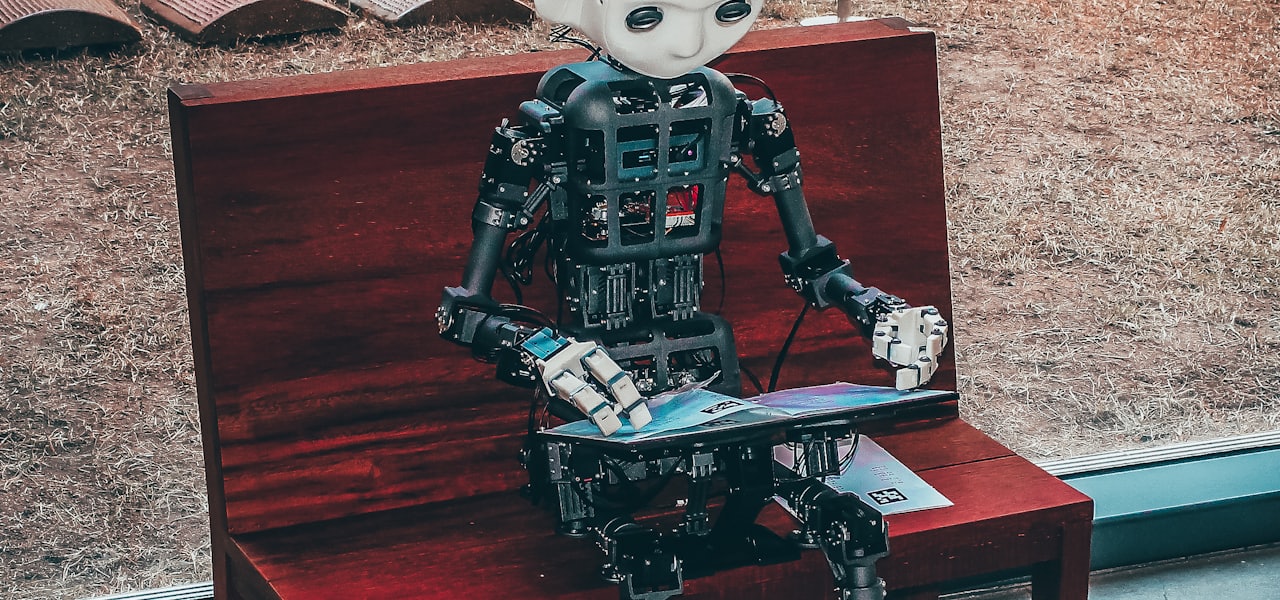
Joint constraints are rotational constraints on the joints of an artificial system. They are used in an inverse kinematics chain, in fields including 3D animation or robotics. Joint constraints can be implemented in a number of ways, but the most common method is to limit rotation about the X, Y and Z axis independently. An elbow, for instance, could be represented by limiting rotation on X and Z axis to 0 degrees, and constraining the Y-axis rotation to 130 degrees. To simulate joint constraints more accurately, dot-products can be used with an independent axis to repulse the child bones orientation from the unreachable axis. Limiting the orientation of the child bone to a border of vectors tangent to the surface of the joint, repulsing the child bone away from the border, can also be useful in the precise restriction of shoulder movement.
Scenery generator
A scenery generator (or terrain generator) is a software used to create landscape images, 3D models, and animations. These programs often use procedural generation to generate the landscapes, or sometimes created and rendered by a 3D artist. These programs are often used in video games or movies. Basic elements of landscapes created by scenery generators include terrain, water, foliage, and clouds. The process for basic random generation uses a diamond square algorithm. == Common features == Most scenery generators can create basic heightmaps to simulate the variation of elevation in basic terrain. Common techniques include Simplex noise, fractals, or the diamond-square algorithm, which can generate 2-dimensional heightmaps. A version of scenery generator can be very simplistic. Using a diamond-square algorithm with some extra steps involving fractals, an algorithm for random generation of terrain can be made with only 120 lines of code. The program in example takes a grid and then divides the grid repeatedly. Each smaller grid is then split into squares and diamonds and the algorithm then makes the randomized terrain for each square and diamond. Most programs for creating landscapes also allow for adjustment and editing of the landscape. For example, World Creator allows for terrain sculpting, which uses a similar brush system as Photoshop, and allows for additional terrain enhancement with its procedural techniques such as erosion, sediments, and more. Other tools in the World Creator program include terrain stamping, which allows you to import elevation maps and use them as a base. The programs tend to also allow for additional placement of rocks, trees, etc. These can be done procedurally or by hand depending on the program. Typically the models used for the placement objects are the same as to lessen the amount of work that would be done if the user was to create a multitude of different trees. The terrain generated the computer does a generation of multifractals then integrates them until finally rendering them onto the screen. These techniques are typically done “on-the-fly” which typically for a 128 × 128 resolution terrain would mean 1.5 seconds on a CPU from the early 1990s. == Applications == Scenery generators are commonly used in movies, animations, 3D rendering, and video games. For example, Industrial Light & Magic used E-on Vue to create the fictional environments for Pirates of the Caribbean: Dead Man's Chest. In such live-action cases, a 3D model of the generated environment is rendered and blended with live-action footage. Scenery generated by the software may also be used to create completely computer-generated scenes. In the case of animated movies such as Kung Fu Panda, the raw generation is assisted by hand-painting to accentuate subtle details. Environmental elements not commonly associated with landscapes, such as ocean waves, have also been handled by the software. Scenery generation is used in most 3D based video-games. These typically use either custom or purchased engines that contain their own scenery generators. For some games they tend to use a procedurally generated terrain. These typically use a form of height mapping and use of Perlin noise. This will create a grid that with one point in a 2D coordinate will create the same heightmap as it is pseudorandom, meaning it will result in the same output with the same input. This can then easily be translated into the product 3D image. These can then be changed from the editor tools in most engines if the terrain will be custom built. With recent developments neural networks can be built to create or texture the terrain based on previously suggested artwork or heightmap data. These would be generated using algorithms that have been able to identify images and similarities between them. With the info the machine can take other heightmaps and render a very similar looking image to the style image. This can be used to create similar images in example a Studio Ghibli or Van Gogh art-style. == Software == Most game engines, whether custom or proprietary, will have terrain generation built in. Some terrain generator programs include, Terragen, which can create terrain, water, atmosphere and lighting; L3DT, which provides similar functions to Terragen, and has a 2048 × 2048 resolution limit; and World Creator, which can create terrain, and is fully GPU powered. === List of 3D terrain generation software ===
Security.txt
security.txt is an accepted standard for website security information that allows security researchers to report security vulnerabilities easily. The standard prescribes a text file named security.txt in the well known location, similar in syntax to robots.txt but intended to be machine and human readable, for those wishing to contact a website's owner about security issues. security.txt files have been adopted by Google, GitHub, LinkedIn, and Facebook. == History == The Internet Draft was first submitted by Edwin Foudil in September 2017. At that time it covered four directives, "Contact", "Encryption", "Disclosure" and "Acknowledgement". Foudil expected to add further directives based on feedback. In addition, web security expert Scott Helme said he had seen positive feedback from the security community while use among the top 1 million websites was "as low as expected right now". In 2019, the Cybersecurity and Infrastructure Security Agency (CISA) published a draft binding operational directive that requires all US federal agencies to publish a security.txt file within 180 days. The Internet Engineering Steering Group (IESG) issued a Last Call for security.txt in December 2019 which ended on January 6, 2020. A study in 2021 found that over ten percent of top-100 websites published a security.txt file, with the percentage of sites publishing the file decreasing as more websites were considered. The study also noted a number of discrepancies between the standard and the content of the file. In April 2022 the security.txt file has been accepted by Internet Engineering Task Force (IETF) as RFC 9116. == File format == security.txt files can be served under the /.well-known/ directory (i.e. /.well-known/security.txt) or the top-level directory (i.e. /security.txt) of a website. The file must be served over HTTPS and in plaintext format.
Metigo
metigo is a software application that performs image-based modelling and close range photogrammetry. It produces rectified imagery plans, true ortho-projections on planar, cylindric and conic surfaces, 3D photorealistic models, measurements from photography and mappings on a photographic base for uses in the cultural heritage sector, mainly conservation. == Products == The metigo product line currently consists of the mapping software metigo MAP, the stereo-photogrammetry modeling software metigo 3D, the free viewer metigo VIEW. These products are all standalone and are not depending on other software, such as AutoCAD. === metigo MAP === metigo MAP is mainly used to map findings and conservation measured on a uniform metric photographic base. Therefore, photos of planar surfaces can be rectified based on geometrical informations, e.g. height and width of a rectangle, or cartesian coordinates measured by total station. Beside rectified imagery several other metric mapping bases can be imported and used: true ortho-projections; scaled scans of plans and plots; CAD-files; 3D models, such as digital surface models (DSM) produced by stereo-photogrammetry, SfM or 3D scanning. metigo MAP 's strong point is that rectified imagery taken with different techniques (visual light, sided light, IR, UV, UV-fluorescence, X-ray), historic images and photos taken at various stages of the conservation process can be superimposed and evaluated mutually. The user can allocate several attributes, such as different conservation measures and damage classes, to the mapped geometries. The mappings can be analysed by geometries as well as by user-defined attributes at any stage of the project. metigo MAP targets mainly conservators in different cultural heritage fields. Using it no specialist knowledge of surveying and photogrammetric techniques are needed. === metigo 3D === metigo 3D is a stereo-photogrammetric kit that allows to calculate bundle adjustments (axios3D), create high-quality 3D point clouds using multiple stereo photo pairs combined with metric survey data, mesh these point clouds, texture the meshes with high-resolution image data to create photo-realistic models, ortho-project orientated images on digital surface models (DSM) on planes and best-fit cylinders and cones, create unwrappings and developed views of curved surfaces, analyse deformations of 3D surfaces. metigo 3D targets metric survey specialists working in the cultural heritage sector. == Supported file formats == metigo has the ability to read the following formats: images: JPEG (.jpg), Tiff (.tif), Bitmaps (.bmp), CompuServ (.gif), Encapsualated Postscript (.eps), PCX (.pcx), Photo-CD (.pcd), PICT (.pcd), PNG (.png), Targa (.tga), RAW-format of several camera brands. CAD: DBX, DXF, DWG. 3D: many ASCII-formats (.stl, .wrl, etc.) point data: format editor for ASCII files. == Supported languages == Currently, an English and German version of the software is supported. For metigo MAP beside these a French and Polish GUI is offered for sale. == Applications == The main applications of metigo are: conservation in the cultural heritage context, e.g. stone conservation paintings tapestry etc. architecture, archaeology, many other are possible, e.g. forensics. == History == The first public release of metigo was in 2000.
Text Database and Dictionary of Classic Mayan
The project Text Database and Dictionary of Classic Mayan (abbr. TWKM) promotes research on the writing and language of pre-Hispanic Maya culture. It is housed in the Faculty of Arts at the University of Bonn and was established with funding from the North Rhine-Westphalian Academy of Sciences, Humanities and the Arts. The project has a projected run-time of fifteen years and is directed by Nikolai Grube from the Department of Anthropology of the Americas at the University of Bonn. The goal of the project is to conduct computer-based studies of all extant Maya hieroglyphic texts from an epigraphic and cultural-historical standpoint, and to produce and publish a database and a comprehensive dictionary of the Classic Mayan language. == Subject of the Project == The text database, as well as the dictionary that will be compiled by the conclusion of the project, will be assembled based on all known texts from the pre-Hispanic Maya culture. These texts were produced and used between approximately the third century B.C. through A.D. 1500, in a region that today includes parts of the countries of Mexico, Guatemala, Belize, and Honduras. The thousands of hieroglyphic inscriptions on monuments, ceramics, or daily objects that have survived into the present offer insight into the language's vocabulary and structure. The project's database and dictionary will digitally represent original spellings using the logo-syllabic Maya hieroglyphs, as well as their transcription and transliteration in the Roman alphabet. The data will be additionally annotated with various epigraphic analyses, translations, and further object-specific information. == Project Partners == TWKM will employ digital technologies in order to compile and make available the data and metadata, as well as to publish the project's research results. The project thereby methodologically positions itself in the field of the digital humanities. The project will be conducted in cooperation with the project partners (below), the research association for the eHumanities TextGrid, as well as the University and Regional Library of Bonn (ULB). The working environment that is currently under construction, in which the data and metadata will be compiled and annotated, will be realized in theTextGrid Laboratory, a software of the virtual research environment. A further component of this software, the TextGrid Repository, will make the data that are authorized for publication freely available online and ensure their long-term storage. The tools for data compilation and annotation attained from the modularly constructed and extended TextGrid lab thereby provide all the necessary materials for facilitating the research team's the typical epigraphic workflow. The workflow usually begins by documenting the texts and the objects on which they are preserved, and by compiling descriptive data. It then continues with the various levels of epigraphic and linguistic analysis, and concludes in the best case scenario with a translation of the analyzed inscription and a corresponding publication. In cooperation with the ULB, selected data will additionally be made available. The project's Virtual Inscription Archive will present online, in the Digital Collections of the ULB, hieroglyphic inscriptions selected from the published data in the repository, including an image of and brief information about the texts and the objects on which they are written, epigraphic analysis, and translation. == Project Goal == One of the project's goals is to produce a dictionary of Classic Mayan, in both digital and print form, towards the end of the project run-time. Additionally, a database with a corpus of inscriptions, including their translations and epigraphic analyses, will be made freely available online. The database furthermore will provide an ontology-like link of the contextual object data with the inscriptions and with each other, thereby allowing a cultural-historical arrangement of all contents within the periods of pre-Hispanic Maya culture. The contents of the database are additionally linked to citations of relevant literature. As a result, the database will also make freely available to both the scientific community and other interested parties a bibliography representing the research history and a base of knowledge concerning ancient Maya culture and script. In addition, the Classic Maya script, in its temporally defined stages of language development, will be gathered into and documented in a comprehensive language corpus with the aid of the information gathered by the project. In collaboration with all project participants, the corpus data can be used, together with the aid of various comparable analyses and also computational linguistic methods, such as inference-based methods, to confirm readings of some hieroglyphs that are currently only partially confirmed, and to eventually completely decipher the Classic Maya script.