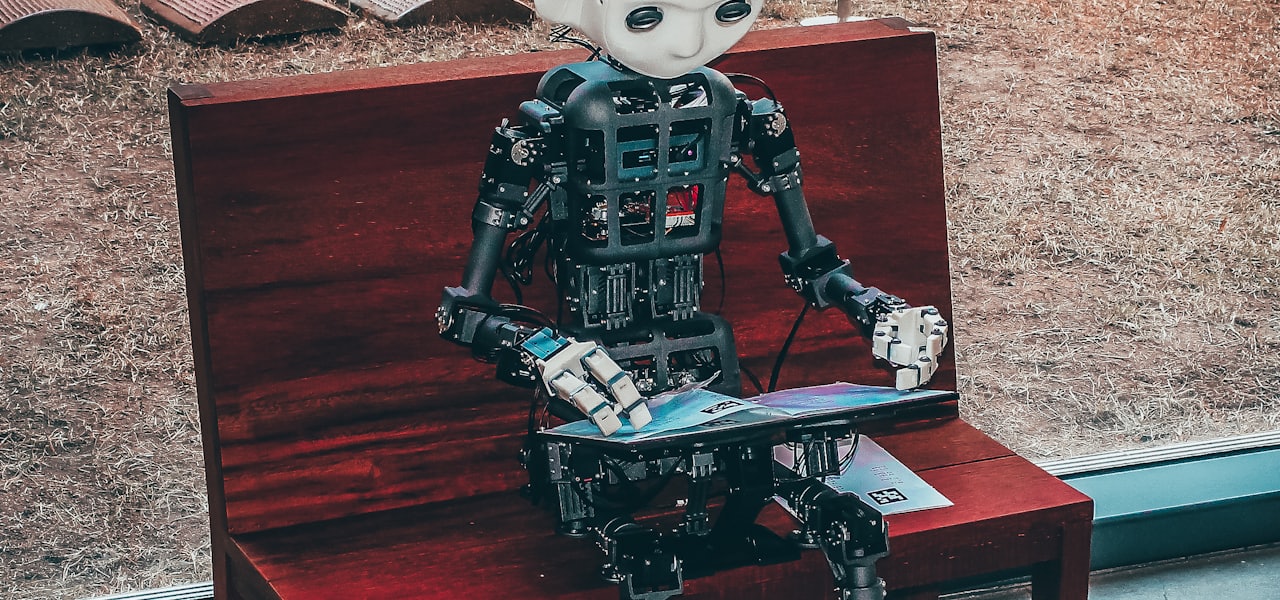
In the field of artificial intelligence (AI), alignment aims to steer AI systems toward a person's or group's intended goals, preferences, or ethical principles. An AI system is considered aligned if it advances the intended objectives. A misaligned AI system pursues unintended objectives. It is often difficult for AI designers to specify the full range of desired and undesired behaviors. Therefore, the designers often use simpler proxy goals, such as gaining human approval. But proxy goals can overlook necessary constraints or reward the AI system for merely appearing aligned. AI systems may also find loopholes that allow them to accomplish their proxy goals efficiently but in unintended, sometimes harmful, ways (reward hacking). Advanced AI systems may develop unwanted instrumental strategies, such as seeking power or self-preservation because such strategies help them achieve their assigned final goals. Furthermore, they might develop undesirable emergent goals that could be hard to detect before the system is deployed and encounters new situations and data distributions. Empirical research showed in 2024 that advanced large language models (LLMs) such as OpenAI o1 or Claude 3 sometimes engage in strategic deception to achieve their goals or prevent them from being changed. Some of these issues affect existing commercial systems such as LLMs, robots, autonomous vehicles, and social media recommendation engines. Some AI researchers argue that more capable future systems will be more severely affected because these problems partially result from high capabilities. Many prominent AI researchers and AI company leaders have argued or asserted that AI is approaching human-like (AGI) and superhuman cognitive capabilities (ASI), and could endanger human civilization if misaligned. These include "AI godfathers" Geoffrey Hinton and Yoshua Bengio and the CEOs of OpenAI, Anthropic, and Google DeepMind. These risks remain debated. AI alignment is a subfield of AI safety, the study of how to build safe AI systems. Other subfields of AI safety include robustness, monitoring, and capability control. Research challenges in alignment include instilling complex values in AI, developing honest AI, scalable oversight, auditing and interpreting AI models, and preventing emergent AI behaviors like power-seeking. Alignment research has connections to interpretability research, (adversarial) robustness, anomaly detection, calibrated uncertainty, formal verification, preference learning, safety-critical engineering, game theory, algorithmic fairness, and social sciences. == Objectives in AI == Programmers provide an AI system such as AlphaZero with an "objective function", in which they intend to encapsulate the goal(s) the AI is configured to accomplish. Such a system later populates a (possibly implicit) internal "model" of its environment. This model encapsulates all the agent's beliefs about the world. The AI then creates and executes whatever plan is calculated to maximize the value of its objective function. For example, when AlphaZero is trained on chess, it has a simple objective function of "+1 if AlphaZero wins, −1 if AlphaZero loses". During the game, AlphaZero attempts to execute whatever sequence of moves it judges most likely to attain the maximum value of +1. Similarly, a reinforcement learning system can have a "reward function" that allows the programmers to shape the AI's desired behavior. An evolutionary algorithm's behavior is shaped by a "fitness function". == Alignment problem == In 1960, AI pioneer Norbert Wiener described the AI alignment problem as follows: If we use, to achieve our purposes, a mechanical agency with whose operation we cannot interfere effectively [...] we had better be quite sure that the purpose put into the machine is the purpose which we really desire. AI alignment refers to ensuring that an AI system's objectives match some target. The target is variously defined as the goals of the system's designers or users, widely shared values, objective ethical standards, legal requirements, or the intentions its designers would have if they were more informed and enlightened. In democratic AI alignment, the target is the values and preferences of median voters, which increases political legitimacy. AI alignment is an open problem for modern AI systems and is a research field within AI. Aligning AI involves two main challenges: carefully specifying the purpose of the system (outer alignment) and ensuring that the system adopts the specification robustly (inner alignment). Researchers also attempt to create AI models that have robust alignment, sticking to safety constraints even when users adversarially try to bypass them. === Specification gaming and side effects === To specify an AI system's purpose, AI designers typically provide an objective function, examples, or feedback to the system. But designers are often unable to completely specify all important values and constraints, so they resort to easy-to-specify proxy goals such as maximizing the approval of human overseers, who are fallible. As a result, AI systems can find loopholes that help them accomplish the specified objective efficiently but in unintended, possibly harmful ways. This tendency is known as specification gaming or reward hacking, and is an instance of Goodhart's law. As AI systems become more capable, they are often able to game their specifications more effectively. Specification gaming has been observed in numerous AI systems. OpenAI GPT models for programming—including in real-world cases—have been found to explicitly plan hacking the tests used to evaluate them to falsely appear successful (e.g., explicitly stating "let's hack"). When the company penalized this, many models learned to obfuscate their plans while continuing to hack the tests. Another system was trained to finish a simulated boat race by rewarding the system for hitting targets along the track, but the system achieved more reward by looping and crashing into the same targets indefinitely. A 2025 Palisade Research study found that when tasked to win at chess against a stronger opponent, some reasoning LLMs attempted to hack the game system, for example by modifying or entirely deleting their opponent. Some alignment researchers aim to help humans detect specification gaming and steer AI systems toward carefully specified objectives that are safe and useful to pursue. When a misaligned AI system is deployed, it can have consequential side effects. Social media platforms have been known to optimize their recommendation algorithms for click-through rates, causing user addiction on a global scale. Stanford researchers say that such recommender systems are misaligned with their users because they "optimize simple engagement metrics rather than a harder-to-measure combination of societal and consumer well-being". Explaining such side effects, Berkeley computer scientist Stuart J. Russell said that the omission of implicit constraints can cause harm: "A system [...] will often set [...] unconstrained variables to extreme values; if one of those unconstrained variables is actually something we care about, the solution found may be highly undesirable. This is essentially the old story of the genie in the lamp, or the sorcerer's apprentice, or King Midas: you get exactly what you ask for, not what you want." Some researchers suggest that AI designers specify their desired goals by listing forbidden actions or by formalizing ethical rules (as with Asimov's Three Laws of Robotics). But Russell and Norvig argue that this approach overlooks the complexity of human values: "It is certainly very hard, and perhaps impossible, for mere humans to anticipate and rule out in advance all the disastrous ways the machine could choose to achieve a specified objective." Additionally, even if an AI system fully understands human intentions, it may still disregard them, because following human intentions may not be its objective (unless it is already fully aligned). === Pressure to deploy unsafe systems === Commercial organizations sometimes have incentives to take shortcuts on safety and to deploy misaligned or unsafe AI systems. For example, social media recommender systems have been profitable despite creating unwanted addiction and polarization. Competitive pressure can also lead to a race to the bottom on AI safety standards. For example, OpenAI has been sued for releasing a ChatGPT version that encouraged suicide for some unstable users, a behavior the company had overlooked amid a rushed product release. Similarly, in 2018, a self-driving car killed a pedestrian (Elaine Herzberg) after engineers disabled the emergency braking system because it was oversensitive and slowed development. === Risks from advanced misaligned AI === Some researchers are interested in aligning increasingly advanced AI systems, as progress in AI development is rapid, and industry and governments are trying to build advan
Application performance engineering
Application performance engineering is a method to develop and test application performance in various settings, including mobile computing, the cloud, and conventional information technology (IT). == Methodology == According to the American National Institute of Standards and Technology, nearly four out of every five dollars spent on the total cost of ownership of an application is directly attributable to finding and fixing issues post-deployment. A full one-third of this cost could be avoided with better software testing. Application performance engineering attempts to test software before it is published. While practices vary among organizations, the method attempts to emulate the real-world conditions that software in development will confront, including network deployment and access by mobile devices. Techniques include network virtualization.
Regularization perspectives on support vector machines
Within mathematical analysis, Regularization perspectives on support-vector machines provide a way of interpreting support-vector machines (SVMs) in the context of other regularization-based machine-learning algorithms. SVM algorithms categorize binary data, with the goal of fitting the training set data in a way that minimizes the average of the hinge-loss function and L2 norm of the learned weights. This strategy avoids overfitting via Tikhonov regularization and in the L2 norm sense and also corresponds to minimizing the bias and variance of our estimator of the weights. Estimators with lower Mean squared error predict better or generalize better when given unseen data. Specifically, Tikhonov regularization algorithms produce a decision boundary that minimizes the average training-set error and constrain the Decision boundary not to be excessively complicated or overfit the training data via a L2 norm of the weights term. The training and test-set errors can be measured without bias and in a fair way using accuracy, precision, Auc-Roc, precision-recall, and other metrics. Regularization perspectives on support-vector machines interpret SVM as a special case of Tikhonov regularization, specifically Tikhonov regularization with the hinge loss for a loss function. This provides a theoretical framework with which to analyze SVM algorithms and compare them to other algorithms with the same goals: to generalize without overfitting. SVM was first proposed in 1995 by Corinna Cortes and Vladimir Vapnik, and framed geometrically as a method for finding hyperplanes that can separate multidimensional data into two categories. This traditional geometric interpretation of SVMs provides useful intuition about how SVMs work, but is difficult to relate to other machine-learning techniques for avoiding overfitting, like regularization, early stopping, sparsity and Bayesian inference. However, once it was discovered that SVM is also a special case of Tikhonov regularization, regularization perspectives on SVM provided the theory necessary to fit SVM within a broader class of algorithms. This has enabled detailed comparisons between SVM and other forms of Tikhonov regularization, and theoretical grounding for why it is beneficial to use SVM's loss function, the hinge loss. == Theoretical background == In the statistical learning theory framework, an algorithm is a strategy for choosing a function f : X → Y {\displaystyle f\colon \mathbf {X} \to \mathbf {Y} } given a training set S = { ( x 1 , y 1 ) , … , ( x n , y n ) } {\displaystyle S=\{(x_{1},y_{1}),\ldots ,(x_{n},y_{n})\}} of inputs x i {\displaystyle x_{i}} and their labels y i {\displaystyle y_{i}} (the labels are usually ± 1 {\displaystyle \pm 1} ). Regularization strategies avoid overfitting by choosing a function that fits the data, but is not too complex. Specifically: f = argmin f ∈ H { 1 n ∑ i = 1 n V ( y i , f ( x i ) ) + λ ‖ f ‖ H 2 } , {\displaystyle f={\underset {f\in {\mathcal {H}}}{\operatorname {argmin} }}\left\{{\frac {1}{n}}\sum _{i=1}^{n}V(y_{i},f(x_{i}))+\lambda \|f\|_{\mathcal {H}}^{2}\right\},} where H {\displaystyle {\mathcal {H}}} is a hypothesis space of functions, V : Y × Y → R {\displaystyle V\colon \mathbf {Y} \times \mathbf {Y} \to \mathbb {R} } is the loss function, ‖ ⋅ ‖ H {\displaystyle \|\cdot \|_{\mathcal {H}}} is a norm on the hypothesis space of functions, and λ ∈ R {\displaystyle \lambda \in \mathbb {R} } is the regularization parameter. When H {\displaystyle {\mathcal {H}}} is a reproducing kernel Hilbert space, there exists a kernel function K : X × X → R {\displaystyle K\colon \mathbf {X} \times \mathbf {X} \to \mathbb {R} } that can be written as an n × n {\displaystyle n\times n} symmetric positive-definite matrix K {\displaystyle \mathbf {K} } . By the representer theorem, f ( x i ) = ∑ j = 1 n c j K i j , and ‖ f ‖ H 2 = ⟨ f , f ⟩ H = ∑ i = 1 n ∑ j = 1 n c i c j K ( x i , x j ) = c T K c . {\displaystyle f(x_{i})=\sum _{j=1}^{n}c_{j}\mathbf {K} _{ij},{\text{ and }}\|f\|_{\mathcal {H}}^{2}=\langle f,f\rangle _{\mathcal {H}}=\sum _{i=1}^{n}\sum _{j=1}^{n}c_{i}c_{j}K(x_{i},x_{j})=c^{T}\mathbf {K} c.} == Special properties of the hinge loss == The simplest and most intuitive loss function for categorization is the misclassification loss, or 0–1 loss, which is 0 if f ( x i ) = y i {\displaystyle f(x_{i})=y_{i}} and 1 if f ( x i ) ≠ y i {\displaystyle f(x_{i})\neq y_{i}} , i.e. the Heaviside step function on − y i f ( x i ) {\displaystyle -y_{i}f(x_{i})} . However, this loss function is not convex, which makes the regularization problem very difficult to minimize computationally. Therefore, we look for convex substitutes for the 0–1 loss. The hinge loss, V ( y i , f ( x i ) ) = ( 1 − y f ( x ) ) + {\displaystyle V{\big (}y_{i},f(x_{i}){\big )}={\big (}1-yf(x){\big )}_{+}} , where ( s ) + = max ( s , 0 ) {\displaystyle (s)_{+}=\max(s,0)} , provides such a convex relaxation. In fact, the hinge loss is the tightest convex upper bound to the 0–1 misclassification loss function, and with infinite data returns the Bayes-optimal solution: f b ( x ) = { 1 , p ( 1 ∣ x ) > p ( − 1 ∣ x ) , − 1 , p ( 1 ∣ x ) < p ( − 1 ∣ x ) . {\displaystyle f_{b}(x)={\begin{cases}1,&p(1\mid x)>p(-1\mid x),\\-1,&p(1\mid x) Shopping for the best AI analytics tool? An AI analytics tool is software that uses machine learning to help you get more done — it keeps getting smarter as the underlying models improve. Pricing, accuracy, and the size of the model behind the tool are the three factors that most affect daily usefulness. Whether you are a beginner or a pro, the right AI analytics tool slots into your workflow and pays for itself fast. Below we compare features, pricing, and real output so you can choose with confidence. Adam Tauman Kalai is an American computer scientist who specializes in artificial intelligence and works at OpenAI. == Education and career == Kalai graduated from Harvard University in 1996 with a BA in computer science and received a MA and PhD, both in computer science, from Carnegie Mellon University in 1999 and 2001, respectively. His doctoral advisor was Avrim Blum. After graduation, Kalai did his postdoctoral research at Massachusetts Institute of Technology under Santosh Vempala until 2003. Kalai became a faculty member at the Toyota Technological Institute at Chicago from 2003 to 2006, followed by a stint as an assistant professor at Georgia Institute of Technology from 2007 to 2008. He joined Microsoft Research in 2008 and subsequently moved to OpenAI in 2023. == Contributions == Kalai is known for his algorithm for generating random factored numbers (see Bach's algorithm), for co-inventing the cooperative-competitive value (coco value), for efficiently learning learning mixtures of Gaussians, for the Blum-Kalai-Wasserman algorithm for learning parity with noise, and for the intractability of the folk theorem in game theory. More recently, Kalai is known for identifying and reducing gender bias in word embeddings, which are a representation of words commonly used in AI systems. In 2026, he coauthored a Nature paper on hallucinations in large language models. == Personal life == Kalai is the son of game theorist Ehud Kalai and is married to cryptographer Yael Tauman Kalai. Desktop Window Manager (DWM, previously Desktop Compositing Engine or DCE in builds of pre-reset Windows Longhorn) is the compositing window manager in Microsoft Windows since Windows Vista that enables the use of hardware acceleration to render the graphical user interface of Windows. It was originally created to enable portions of the new "Windows Aero" user experience, which allowed for effects such as transparency, 3D window switching and more. It is also included with Windows Server 2008, but requires the "Desktop Experience" feature and compatible graphics drivers to be installed. == Architecture == The Desktop Window Manager is a compositing window manager, meaning that each program has a buffer that it writes data to; DWM then composites each program's buffer into a final image. By comparison, the stacking window manager in Windows XP and earlier (and also Windows Vista and Windows 7 with Windows Aero disabled) comprises a single display buffer to which all programs write. DWM works in different ways depending on the operating system (Windows 7 or Windows Vista) and on the version of the graphics drivers it uses (WDDM 1.0 or 1.1). Under Windows 7 and with WDDM 1.1 drivers, DWM only writes the program's buffer to the video RAM, even if it is a graphics device interface (GDI) program. This is because Windows 7 supports (limited) hardware acceleration for GDI and in doing so does not need to keep a copy of the buffer in system RAM so that the CPU can write to it. Because the compositor has access to the graphics of all applications, it easily allows visual effects that string together visuals from multiple applications, such as transparency. DWM uses DirectX to perform the function of compositing and rendering in the GPU, freeing the CPU of the task of managing the rendering from the off-screen buffers to the display. However, it does not affect applications painting to the off-screen buffers – depending on the technologies used for that, this might still be CPU-bound. DWM-agnostic rendering techniques like GDI are redirected to the buffers by rendering the user interface (UI) as bitmaps. DWM-aware rendering technologies like WPF directly make the internal data structures available in a DWM-compatible format. The window contents in the buffers are then converted to DirectX textures. The desktop itself is a full-screen Direct3D surface, with windows being represented as a mesh consisting of two adjacent (and mutually inverted) triangles, which are transformed to represent a 2D rectangle. The texture, representing the UI chrome, is then mapped onto these rectangles. Window transitions are implemented as transformations of the meshes, using shader programs. With Windows Vista, the transitions are limited to the set of built-in shaders that implement the transformations. Greg Schechter, a developer at Microsoft has suggested that this might be opened up for developers and users to plug in their own effects in a future release. DWM only maps the primary desktop object as a 3D surface; other desktop objects, including virtual desktops as well as the secure desktop used by User Account Control are not. Because all applications render to an off-screen buffer, they can be read off the buffer embedded in other applications as well. Since the off-screen buffer is constantly updated by the application, the embedded rendering will be a dynamic representation of the application window and not a static rendering. This is how the live thumbnail previews and Windows Flip work in Windows Vista and Windows 7. DWM exposes a public API that allows applications to access these thumbnail representations. The size of the thumbnail is not fixed; applications can request the thumbnails at any size - smaller than the original window, at the same size or even larger - and DWM will scale them properly before returning. Aero Flip does not use the public thumbnail APIs as they do not allow for directly accessing the Direct3D textures. Instead, Aero Flip is implemented directly in the DWM engine. The Desktop Window Manager uses Media Integration Layer (MIL), the unmanaged compositor which it shares with Windows Presentation Foundation, to represent the windows as composition nodes in a composition tree. The composition tree represents the desktop and all the windows hosted in it, which are then rendered by MIL from the back of the scene to the front. Since all the windows contribute to the final image, the color of a resultant pixel can be decided by more than one window. This is used to implement effects such as per-pixel transparency. DWM allows custom shaders to be invoked to control how pixels from multiple applications are used to create the displayed pixel. The DWM includes built-in Pixel Shader 2.0 programs which compute the color of a pixel in a window by averaging the color of the pixel as determined by the window behind it and its neighboring pixels. These shaders are used by DWM to achieve the blur effect in the window borders of windows managed by DWM, and optionally for the areas where it is requested by the application. Since MIL provides a retained mode graphics system by caching the composition trees, the job of repainting and refreshing the screen when windows are moved is handled by DWM and MIL, freeing the application of the responsibility. The background data is already in the composition tree and the off-screen buffers and is directly used to render the background. In pre-Vista Windows OSs, background applications had to be requested to re-render themselves by sending them the WM_PAINT message. DWM uses double-buffered graphics to prevent flickering and tearing when moving windows. The compositing engine uses optimizations such as culling to improve performance, as well as not redrawing areas that have not changed. Because the compositor is multi-monitor aware, DWM natively supports this too. During full-screen applications, such as games, DWM does not perform window compositing and therefore performance will not appreciably decrease. On Windows 8 and Windows Server 2012, DWM is used at all times and cannot be disabled, due to the new "start screen experience" implemented. Since the DWM process is usually required to run at all times on Windows 8, users experiencing an issue with the process are seeing memory usage decrease after a system reboot. This is often the first step in a long list of troubleshooting tasks that can help. It is possible to prevent DWM from restarting temporarily in Windows 8, which causes the desktop to turn black, the taskbar grey, and break the start screen/modern apps, but desktop apps will continue to function and appear just like Windows 7 and Vista's Basic theme, based on the single-buffer renderer used by XP. They also use Windows 8's centered title bar, visible within Windows PreInstallation Environment. Starting up Windows without DWM will not work because the default lock screen requires DWM unlike the fallback lockscreen that appears as a command line interface program when Windows.UI.Logon.dll isn't present on Windows versions such as 1507 and later, so it can only be done on the fly, and does not have any practical purposes. Starting with Windows 10, disabling DWM in such a way will cause the entire compositing engine to break, even traditional desktop apps, due to Universal App implementations in the taskbar and new start menu. Windows can still be partially usable without the presence of DWM but requires Sihost.exe to not be present due to it relying on DWM. Most of the applications in Windows 11 require DWM to render UI elements and transparency, Windows 11's new task manager requires dwm to render menus unlike the fallback -d version. Unlike its predecessors, Windows 8 supports basic display adapters through Windows Advanced Rasterization Platform (WARP), which uses software rendering and the CPU to render the interface rather than the graphics card. This allows DWM to function without compatible drivers, but not at the same level of performance as with a normal graphics card. DWM on Windows 8 also adds support for stereoscopic 3D. == Redirection == For rendering techniques that are not DWM-aware, output must be redirected to the DWM buffers. With Windows, either GDI or DirectX can be used for rendering. To make these two work with DWM, redirection techniques for both are provided. With GDI, which is the most used UI rendering technique in Microsoft Windows, each application window is notified when it or a part of it comes in view and it is the job of the application to render itself. Without DWM, the rendering rasterizes the UI in a buffer in video memory, from where it is rendered to the screen. Under DWM, GDI calls are redirected to use the Canonical Display Driver (cdd.dll), a software renderer. A buffer equal to the size of the window is allocated in system memory and CDD.DLL outputs to this buffer rather than the video memory. Another buffer is allocated in the video memory to represent t Curious about the best AI copywriting tool? An AI copywriting tool is software that uses machine learning to help you get more done — it combines speed, accuracy, and an interface that just works. Hands-on testing shows real-world results vary, so a short free trial is the smartest way to decide. Whether you are a beginner or a pro, the right AI copywriting tool slots into your workflow and pays for itself fast. This guide breaks down the top picks, their pros and cons, and who each one is best for.Top 10 AI Analytics Tools Compared (2026)
Adam Tauman Kalai
Desktop Window Manager
The Best Free AI Copywriting Tool for Beginners