In 2022, 16.9% (1,620) of the 9,586 Brazilian industrial companies with 100 or more employees used artificial intelligence in their operations Among the companies that used AI, the areas of administration (73.8%), product project development (65.9%), processes, services and marketing (65.1%) were those that used it the most, followed by the areas of production (56.4%) and logistics (48.4%). == Current scenario == === Adoption in Brazilian industrial sectors === In senior management, the majority (56%) of executives have a long-term vision for its use. The study also shows that IT, Innovation, and Marketing are the areas where AI use is most widespread, and that 43% of companies are developing or adapting the algorithms they use. The majority of large institutions that reported some type of AI use purchased these solutions from other companies (76%). Some factors for the adoption of artificial intelligence in companies include the establishment of an autonomous strategy by the company (87.0%), and the influence of suppliers and/or customers (63.0%) and the main difficulties in using technologies were high costs (80.8%), lack of qualified personnel in the company (54.6%) and excessive economic risks (49.5%). Three variables are considered the most relevant to explain the option to use AI: the implementation of a digital security policy, the size of companies with 250 or more employees and the characteristics of the company related to information and communication. When analyzing AI use by company size in Brazil, large companies have the highest proportion of AI use, mainly due to their investment capacity and technology experimentation. However, when comparing Brazil and Europe, indicators show an acceleration in AI use among large European companies, while in Brazil the situation remains stable. In 2023, 30% of large companies in the European bloc used some type of AI, a figure that rose to 41% in 2024, while in Brazil these proportions were 41% in 2023 and 38% in 2024. === Workforce === The challenge of upskilling begins with employees who are capable of understanding recent technological changes. Similarly, companies must create the environment and conditions for workforce development conducive to innovation, and universities must be prepared to provide knowledge aligned with the transition process, which in turn must be supported by public policies. The concern with training a specialized workforce in AI can be seen in the low number of graduates and PhDs in computer science and computer engineering in Brazil, compared to the number shown in other countries. As recorded in the document Recommendations for the Advancement of Artificial Intelligence in Brazil, 2019 data from the Coordination for the Improvement of Higher Education Personnel (CAPES) indicate that "the number of PhDs graduated annually in computing remained below 400 in 2016, and is not expected to have increased during the Covid-19 pandemic" (ABC, 2023). In the United States, by contrast, the number of PhDs graduated in these two areas has remained around 1,800 for the past 11 years, and during this period, the number of PhDs specializing in AI jumped from 10% to 19%. Based on data from the CNPq Lattes Platform (October 2019), it is possible to observe that the number of professionals in the AI field in Brazil is 4,429 specialists. This is still a small number compared to the 415,166 IT jobs in the country's business sector alone. === R&D, scientific production and integration with industry === China and the United States lead in the number of publications. These two countries are followed by the G7 members: India, Austria, South Korea, and Spain. Brazil appears in the next group, alongside the Netherlands, Russia, Indonesia, and Ireland. Regarding the promotion of research and technologies related to AI, public entities such as the Coordination for the Improvement of Higher Education Personnel (Capes) and the National Council for Scientific and Technological Development (CNPq) stood out as the main funders. Currently, different countries and territories have been promoting the development of Artificial Intelligence (AI). In the Brazilian case, one of the main initiatives is the creation of Engineering Research Centers/Applied Research Centers (CPE/CPA) in AI by the São Paulo Research Foundation (FAPESP), in collaboration with the Ministry of Science, Technology and Innovation (MCTI), the Ministry of Communications (MC) and the Brazilian Internet Steering Committee (CGI.br). In terms of the number of patents filed and the volume of investments, the leading nations in AI are the United States, China, France, Germany, the United Kingdom, Russia, India, Switzerland, Japan, South Korea, the Netherlands, Sweden, Finland, Ireland, Singapore, Canada, Israel, and Italy. Brazil appears among the top twenty countries in some rankings, mainly due to its good number of publications (approximately 10% of the number of articles published by the United States). The US is home to approximately 60% of the world's top AI researchers, followed by China (11%), Europe (10%), and Canada (6%). To change this scenario, in August 2024, the Brazilian government announced an investment of R$23 billion until 2028 in artificial intelligence, seeking to “transform the country into a global reference in innovation”. == Future challenges == The Organization for Economic Cooperation and Development (2020) report highlighted three factors that hinder the digital transformation journey and application of AI in Brazil: insufficient infrastructure, high costs due to the tax system, and financial limitations, such as limited access to financing. The costs of adopting technology, its incompatibility with the business, and the lack of training also represent obstacles that Brazilian industry must overcome. There are also inherent obstacles for companies. A McKinsey review emphasizes that once a company chooses one or more sectors to focus on, it must select specific applications. Buyers aren't interested in artificial intelligence simply because it's a breakthrough technology; they want AI to generate a good return on investment, whether by solving specific problems, saving money, or increasing sales. If an AI vendor tried to offer a horizontal solution, the value proposition might not be as compelling. Part of the solution to Brazil's technological backwardness involves building an ecosystem fueled by private institutions, universities, and governments.
AI Security Institute
The AI Security Institute (AISI) is a research organisation under the Department for Science, Innovation and Technology, UK, that aims "to equip governments with a scientific understanding of the risks posed by advanced AI". It conducts research and develop and test mitigations. Previously, it was known as the AI Safety Institute. Its creation followed world's first major AI Safety Summit that was held in Bletchley Park in 2023. The institute's professed goal is "building the world's leading understanding of advanced AI risks and solutions, to inform governments so they can keep the public safe". It is designed like a startup in the government "combining the authority of government with the expertise and agility of the private sector". AISI has made access agreements with Anthropic, Google and OpenAI to test their models before release. It has an open source platform called Inspect that permits companies, governments and academics to run standardised safety tests for AI usage. Among the works AISI has done is the reported detection of multiple serious vulnerabilities that could enable development of biological weapons; the vulnerabilities were fixed before the model was launched. It conducts research on diverse fields of AI application. One study by AISI found that LLMs post-trained for political persuasiveness became systematically less accurate and up to 51% more persuasive on political issues. AISI has also worked on the usage of AI for emotional needs. It found that nearly 10 percent of UK citizens used systems like chatbots for emotional purposes on a weekly basis. It found that "systems are now outperforming PhD-level researchers on scientific knowledge tests and helping non-experts succeed at lab work that would previously have been out of reach" in a report published in December 2025. Former chief AI officer of GCHQ Adam Beaumont is the institution's interim director. UK prime minister's AI advisor Jade Leung is the chief technology officer.
Machine unlearning
Machine unlearning is a branch of machine learning focused on removing specific undesired element, such as private data, wrong or manipulated training data, outdated information, copyrighted material, harmful content, dangerous abilities, or misinformation, without needing to rebuild models from the ground up. Large language models, like the ones powering ChatGPT, may be asked not just to remove specific elements but also to unlearn a "concept," "fact," or "knowledge," which aren't easily linked to specific examples. New terms such as "model editing," "concept editing," and "knowledge unlearning" have emerged to describe this process. == History == Early research efforts were largely motivated by Article 17 of the GDPR, the European Union's privacy regulation commonly known as the "right to be forgotten" (RTBF), introduced in 2014. The GDPR did not anticipate that the development of large language models would make data erasure a complex task. This issue has since led to research on "machine unlearning," with a growing focus on removing copyrighted material, harmful content, dangerous capabilities, and misinformation. Just as early experiences in humans shape later ones, some concepts are more fundamental and harder to unlearn. A piece of knowledge may be so deeply embedded in the model's knowledge graph that unlearning it could cause internal contradictions, requiring adjustments to other parts of the graph to resolve them. Researchers have now also started studying unlearning in the context of removing incorrect or adversarially manipulated training data such as systematically biased labels or poisoning attacks. == Motivations == At present, machine unlearning is motivated by a growing range of concerns that extend well beyond the field's original focus on data privacy. A widely used taxonomy in the literature distinguishes two high-level categories of motivation. Access revocation covers cases where a data subject or rights holder requests the removal of data they own or control. This is most commonly associated with RTBF established by the European Union's General Data Protection Regulation (GDPR) and analogous legislation such as the California Consumer Privacy Act (CCPA). These regulations grant individuals the legal right to request erasure of their personal data from any system that has processed it, including models that were trained on it. Access revocation also encompasses the removal of copyrighted or pay-walled content that was incorporated into training corpora without the necessary licenses, a concern that has become prominent with the widespread use of largely web-scraped pre-training datasets. Model correction covers cases where the model exhibits undesirable behavior arising from the training data, regardless of any individual's request. This includes: Removal of toxic, biased, or unsafe outputs introduced by harmful content in the training set Correction of stale or factually incorrect associations, such as outdated knowledge encoded in a deployed model Removal of dangerous capabilities, such as detailed knowledge of the synthesis of chemical or biological agents Correction of the influence of data poisoning or adversarial attacks that have corrupted model behavior This second category has been formalized as corrective machine unlearning, which frames unlearning as a post-training mechanism for repairing the effects of bad or harmful training data. It is closely related to the AI safety literature, where data filtering alone has been found insufficient to prevent hazardous knowledge from being encoded in model weights, motivating unlearning as a complementary risk mitigation strategy. A further distinction has been drawn in the literature between removal {eliminating the influence of specific training data on model parameters) and suppression (preventing the model from generating specific outputs regardless of how that knowledge is encoded). These two goals are not equivalent: removing training data does not guarantee meaningful output suppression, and suppressing outputs does not constitute removal of the underlying training data's influence. == SISA Training == SISA is a training strategy consisting of four mechanisms designed to make machine unlearning more efficient by structuring how models are trained and updated. Its goal is to allow a system to remove the influence of specific data points without retraining an entire model from scratch. By reorganizing training data and workflows, SISA reduces the computational burden of unlearning requests. Sharding divides the training dataset into multiple disjoint subsets, or shards. Each shard is used to train a separate model instance. This ensures that a single data point affects only one shard, so unlearning it requires updating only the corresponding shard rather than the full model. Isolation refers to training each shard independently, with nothing shared across shards during the training process. This separation prevents cross-contamination between shards, ensuring that forgetting data in one shard does not require adjustments to any others. Slicing breaks the data within each shard into sequential slices and stores model states after each slice is trained on. When an unlearning request targets a piece of data, the system can roll back to the checkpoint before the point was seen and retrain only from that slice forward. This reduces retraining time even within a shard. Aggregation occurs at inference, when the model is queried. It combines the outputs of each shard to determine the output of the overall model. This is often through majority voting or averaging. This allows SISA-trained systems to behave like a single model despite being composed of multiple shard-level models. Together, these mechanisms enable machine learning systems to forget specific data points with far lower computational cost than full retraining. The trade-off is that sharding and slicing can lead to reduced model accuracy, worse generalization, and increased storage requirements for the intermediate checkpoints. This can be tolerable based on the needs of the individual or organization to comply with "right to be forgotten" or efficiently recover from backdoor attacks. == Algorithms == Machine unlearning algorithms are broadly categorized into exact and approximate methods, reflecting a fundamental trade-off between formal guarantees and computational tractability. === Exact Unlearning === Exact unlearning methods produce a model that is statistically indistinguishable from one retrained from scratch on the dataset with the forget data removed. The canonical framework for exact unlearning is SISA Training (Sharded, Isolated, Sliced, and Aggregated), introduced by Bourtoule et al. (2021). SISA partitions the training dataset into disjoint shards and trains a separate sub-model on each. At inference time, predictions are aggregated across sub-models. When an unlearning request is received, only the sub-model corresponding to the shard containing the target data requires retraining, reducing computational overhead proportionally to the number of shards. Exact methods provide the strongest guarantees but become prohibitively expensive for large pre-trained neural networks and are generally limited to settings where training can be structured in advance. === Approximate Unlearning === Approximate unlearning methods seek to produce a model whose behavior is sufficiently close to an exactly unlearned model without the cost of full retraining. These methods dominate practical applications. Common approaches include: Gradient Ascent: The model is fine-tuned by maximizing the loss on the forget set, directly degrading its performance on targeted data. This is the most direct approach but risks destabilizing performance on retained data. Random Labelling: The model is fine-tuned on the forget set using randomly shuffled labels, confusing its associations with the targeted data while producing a less aggressive weight shift than pure gradient ascent. Gradient Difference: Combines gradient ascent on the forget set with simultaneous gradient descent on the retain set, using the retain objective as a regularizer to preserve general model utility. KL Divergence Regularization: Minimizes the KL divergence between the outputs of the unlearned model and the original model on the retain set, anchoring behavior on data the model should remember. Weight Pruning and Fine-tuning: Parameters with the smallest L1-norm are pruned — targeting weights most weakly associated with general knowledge and potentially most associated with the forget set — followed by fine-tuning on the retain set to restore utility. Layer Reset and Fine-tuning: The first or last k layers are re-initialized to random weights and the model is subsequently fine-tuned on the retain set. This is a coarse but computationally simple approach. Selective Synaptic Dampening: Uses influence functions to estimate the effect of individual trainin
Autonomic networking
Autonomic networking follows the concept of Autonomic Computing, an initiative started by IBM in 2001. Its ultimate aim is to create self-managing networks to overcome the rapidly growing complexity of the Internet and other networks and to enable their further growth, far beyond the size of today. == Increasing size and complexity == The ever-growing management complexity of the Internet caused by its rapid growth is seen by some experts as a major problem that limits its usability in the future. What's more, increasingly popular smartphones, PDAs, networked audio and video equipment, and game consoles need to be interconnected. Pervasive Computing not only adds features, but also burdens existing networking infrastructure with more and more tasks that sooner or later will not be manageable by human intervention alone. Another important aspect is the price of manually controlling huge numbers of vitally important devices of current network infrastructures. == Autonomic nervous system == The autonomic nervous system (ANS) is the part of complex biological nervous systems that is not consciously controlled. It regulates bodily functions and the activity of specific organs. As proposed by IBM, future communication systems might be designed in a similar way to the ANS. == Components of autonomic networking == As autonomics conceptually derives from biological entities such as the human autonomic nervous system, each of the areas can be metaphorically related to functional and structural aspects of a living being. In the human body, the autonomic system facilitates and regulates a variety of functions including respiration, blood pressure and circulation, and emotive response. The autonomic nervous system is the interconnecting fabric that supports feedback loops between internal states and various sources by which internal and external conditions are monitored. === Autognostics === Autognostics includes a range of self-discovery, awareness, and analysis capabilities that provide the autonomic system with a view on high-level state. In metaphor, this represents the perceptual sub-systems that gather, analyze, and report on internal and external states and conditions – for example, this might be viewed as the eyes, visual cortex and perceptual organs of the system. Autognostics, or literally "self-knowledge", provides the autonomic system with a basis for response and validation. A rich autognostic capability may include many different "perceptual senses". For example, the human body gathers information via the usual five senses, the so-called sixth sense of proprioception (sense of body position and orientation), and through emotive states that represent the gross wellness of the body. As conditions and states change, they are detected by the sensory monitors and provide the basis for adaptation of related systems. Implicit in such a system are imbedded models of both internal and external environments such that relative value can be assigned to any perceived state - perceived physical threat (e.g. a snake) can result in rapid shallow breathing related to fight-flight response, a phylogenetically effective model of interaction with recognizable threats. In the case of autonomic networking, the state of the network may be defined by inputs from: individual network elements such as switches and network interfaces including specification and configuration historical records and current state traffic flows end-hosts application performance data logical diagrams and design specifications Most of these sources represent relatively raw and unprocessed views that have limited relevance. Post-processing and various forms of analysis must be applied to generate meaningful measurements and assessments against which current state can be derived. The autognostic system interoperates with: configuration management - to control network elements and interfaces policy management - to define performance objectives and constraints autodefense - to identify attacks and accommodate the impact of defensive responses === Configuration management === Configuration management is responsible for the interaction with network elements and interfaces. It includes an accounting capability with historical perspective that provides for the tracking of configurations over time, with respect to various circumstances. In the biological metaphor, these are the hands and, to some degree, the memory of the autonomic system. On a network, remediation and provisioning are applied via configuration setting of specific devices. Implementation affecting access and selective performance with respect to role and relationship are also applied. Almost all the "actions" that are currently taken by human engineers fall under this area. With only a few exceptions, interfaces are set by hand, or by extension of the hand, through automated scripts. Implicit in the configuration process is the maintenance of a dynamic population of devices under management, a historical record of changes and the directives which invoked change. Typical to many accounting functions, configuration management should be capable of operating on devices and then rolling back changes to recover previous configurations. Where change may lead to unrecoverable states, the sub-system should be able to qualify the consequences of changes prior to issuing them. As directives for change must originate from other sub-systems, the shared language for such directives must be abstracted from the details of the devices involved. The configuration management sub-system must be able to translate unambiguously between directives and hard actions or to be able to signal the need for further detail on a directive. An inferential capacity may be appropriate to support sufficient flexibility (i.e. configuration never takes place because there is no unique one-to-one mapping between directive and configuration settings). Where standards are not sufficient, a learning capacity may also be required to acquire new knowledge of devices and their configuration. Configuration management interoperates with all of the other sub-systems including: autognostics - receives direction for and validation of changes policy management - implements policy models through mapping to underlying resources security - applies access and authorization constraints for particular policy targets autodefense - receives direction for changes === Policy management === Policy management includes policy specification, deployment, reasoning over policies, updating and maintaining policies, and enforcement. Policy-based management is required for: constraining different kinds of behavior including security, privacy, resource access, and collaboration configuration management describing business processes and defining performance defining role and relationship, and establishing trust and reputation It provides the models of environment and behavior that represent effective interaction according to specific goals. In the human nervous system metaphor, these models are implicit in the evolutionary "design" of biological entities and specific to the goals of survival and procreation. Definition of what constitutes a policy is necessary to consider what is involved in managing it. A relatively flexible and abstract framework of values, relationships, roles, interactions, resources, and other components of the network environment is required. This sub-system extends far beyond the physical network to the applications in use and the processes and end-users that employ the network to achieve specific goals. It must express the relative values of various resources, outcomes, and processes and include a basis for assessing states and conditions. Unless embodied in some system outside the autonomic network or implicit to the specific policy implementation, the framework must also accommodate the definition of process, objectives and goals. Business process definitions and descriptions are then an integral part of the policy implementation. Further, as policy management represents the ultimate basis for the operation of the autonomic system, it must be able to report on its operation with respect to the details of its implementation. The policy management sub-system interoperates (at least) indirectly with all other sub-systems but primarily interacts with: autognostics - providing the definition of performance and accepting reports on conditions configuration management - providing constraints on device configuration security - providing definitions of roles, access and permissions === Autodefense === Autodefense represents a dynamic and adaptive mechanism that responds to malicious and intentional attacks on the network infrastructure, or use of the network infrastructure to attack IT resources. As defensive measures tend to impede the operation of IT, it is optimally capable of balancing performance objectives with typically over-riding threat management actions. In the
Embodied agent
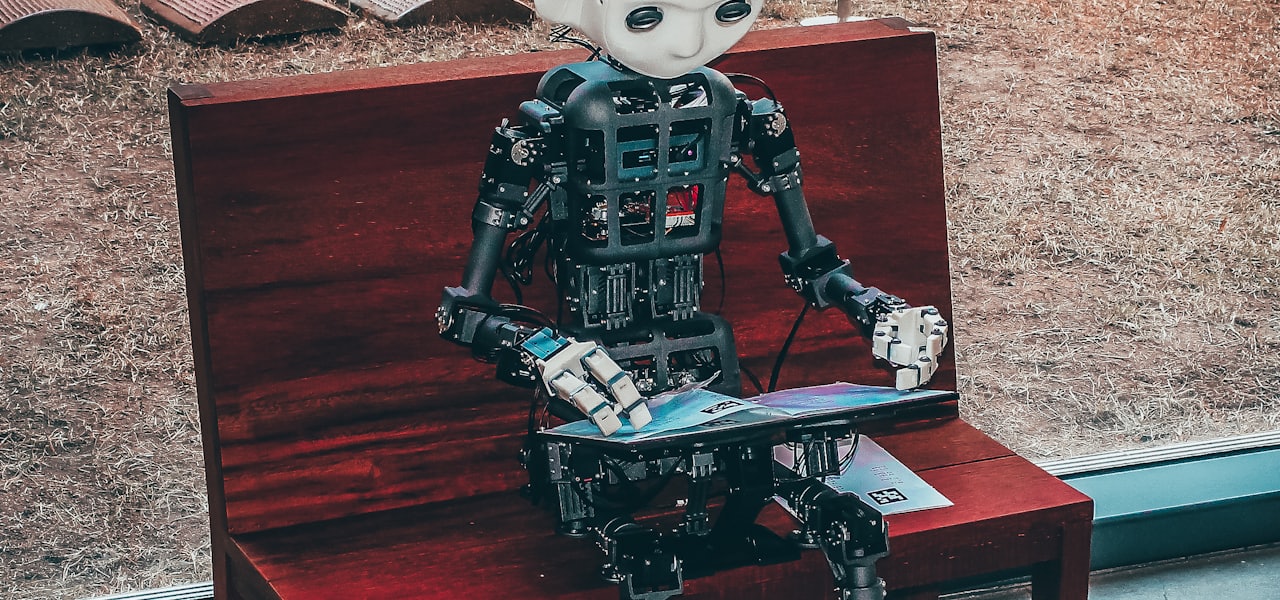
In artificial intelligence, an embodied agent, also sometimes referred to as an interface agent, is an intelligent agent that interacts with the environment through a physical body within that environment. Agents that are represented graphically with a body, for example a human or a cartoon animal, are also called embodied agents, although they have only virtual, not physical, embodiment. A branch of artificial intelligence focuses on empowering such agents to interact autonomously with human beings and the environment. Mobile robots are one example of physically embodied agents; Ananova and Microsoft Agent are examples of graphically embodied agents. Embodied conversational agents are embodied agents (usually with a graphical front-end as opposed to a robotic body) that are capable of engaging in conversation with one another and with humans employing the same verbal and nonverbal means that humans do (such as gesture, facial expression, and so forth). == Embodied conversational agents == Embodied conversational agents are a form of intelligent user interface. Graphically embodied agents aim to unite gesture, facial expression and speech to enable face-to-face communication with users, providing a powerful means of human-computer interaction. == Advantages == Face-to-face communication allows communication protocols that give a much richer communication channel than other means of communicating. It enables pragmatic communication acts such as conversational turn-taking, facial expression of emotions, information structure and emphasis, visualization and iconic gestures, and orientation in a three-dimensional environment. This communication takes place through both verbal and non-verbal channels such as gaze, gesture, spoken intonation and body posture. Research has found that users prefer a non-verbal visual indication of an embodied system's internal state to a verbal indication, demonstrating the value of additional non-verbal communication channels. As well as this, the face-to-face communication involved in interacting with an embodied agent can be conducted alongside another task without distracting the human participants, instead improving the enjoyment of such an interaction. Furthermore, the use of an embodied presentation agent results in improved recall of the presented information. Embodied agents also provide a social dimension to the interaction. Humans willingly ascribe social awareness to computers, and thus interaction with embodied agents follows social conventions, similar to human to human interactions. This social interaction both raises the believably and perceived trustworthiness of agents, and increases the user's engagement with the system. Rickenberg and Reeves found that the presence of an embodied agent on a website increased the level of user trust in that website, but also increased users' anxiety and affected their performance, as if they were being watched by a real human. Another effect of the social aspect of agents is that presentations given by an embodied agent are perceived as being more entertaining and less difficult than similar presentations given without an agent. Research shows that perceived enjoyment, followed by perceived usefulness and ease of use, is the major factor influencing user adoption of embodied agents. A study in January 2004 by Byron Reeves at Stanford demonstrated how digital characters could "enhance online experiences" through explaining how virtual characters essentially add a sense of familiarity to the user experience and make it more approachable. This increase in likability in turn helps make the products better, which benefits both the end users and those creating the product. === Applications === The rich style of communication that characterizes human conversation makes conversational interaction with embodied conversational agents ideal for many non-traditional interaction tasks. A familiar application of graphically embodied agents is computer games; embodied agents are ideal for this setting because the richer communication style makes interacting with the agent enjoyable. Embodied conversational agents have also been used in virtual training environments, portable personal navigation guides, interactive fiction and storytelling systems, interactive online characters and automated presenters and commentators. Major virtual assistants like Siri, Amazon Alexa and Google Assistant do not come with any visual embodied representation, which is believed to limit the sense of human presence by users. The U.S. Department of Defense utilizes a software agent called SGT STAR on U.S. Army-run Web sites and Web applications for site navigation, recruitment and propaganda purposes. Sgt. Star is run by the Army Marketing and Research Group, a division operated directly from The Pentagon. Sgt. Star is based upon the ActiveSentry technology developed by Next IT, a Washington-based information technology services company. Other such bots in the Sgt. Star "family" are utilized by the Federal Bureau of Investigation and the Central Intelligence Agency for intelligence gathering purposes.
Pwnie Awards
The Pwnie Awards are an annual awards ceremony that recognizes both excellence and incompetence in the field of information security, described by SecurityWeek as an event that "recognizes excellence and mocks incompetence in cybersecurity." Winners are selected by a committee of security industry professionals from nominations collected from the information security community. Nominees are announced yearly at Summercon, and the awards themselves are presented at the Black Hat Security Conference. == Origins == The name Pwnie Award is based on the word "pwn", which is hacker slang meaning to "compromise" or "control" based on the previous usage of the word "own" (and it is pronounced similarly). The name "The Pwnie Awards," pronounced as "Pony," is meant to sound like the Tony Awards, an awards ceremony for Broadway theater in New York City. == History == The Pwnie Awards were founded in 2007 by Alexander Sotirov and Dino Dai Zovi following discussions regarding Dino's discovery of a cross-platform QuickTime vulnerability (CVE-2007-2175) and Alexander's discovery of an ANI file processing vulnerability (CVE-2007-0038) in Internet Explorer. == Winners == === 2024 === Most Epic Fail: Crowdstrike for 2024 CrowdStrike incident Best Mobile Bug: Operation Triangulation Lamest Vendor Response: Xiaomi for obstructing Pwn2Own researchers from using their services Best Cryptographic Attack: GoFetch Best Desktop Bug: forcing realtime WebAudio playback in Chrome (CVE-2023-5996) Best Song: Touch Some Grass by UwU Underground Best Privilege Escalation: Windows Streaming Service UAF (CVE-2024-30089) by Valentina Palmiotti (chompie) Best Remote Code Execution: Microsoft Message Queuing (MSMQ) Remote Code Execution Vulnerability (CVE-2024-30080) Most Epic Achievement: Discovery and reverse engineering of the XZ Utils backdoor Most Innovative Research: Let the Cache Cache and Let the WebAssembly Assemble: Knocking’ on Chrome’s Shell by Edouard Bochin, Tao Yan, and Bo Qu Most Underhyped Research: See No Eval: Runtime Dynamic Code Execution in Objective-C === 2023 === Best Desktop Bug: CountExposure! by RyeLv(@b2ahex) Best Cryptographic Attack: Video-based cryptanalysis: Extracting Cryptographic Keys from Video Footage of a Device’s Power LED by Ben Nassi, Etay Iluz, Or Cohen, Ofek Vayner, Dudi Nassi, Boris Zadov, Yuval Elovici Best Song: Clickin’ Most Innovative Research: Inside Apple’s Lightning: Jtagging the iPhone for Fuzzing and Profit Most Under-Hyped Research: Activation Context Cache Poisoning Best Privilege Escalation Bug: URB Excalibur: Slicing Through the Gordian Knot of VMware VM Escapes Best Remote Code Execution Bug: ClamAV RCE Lamest Vendor Response: Three Lessons From Threema: Analysis of a Secure Messenger Most Epic Fail: “Holy fucking bingle, we have the no fly list,” Epic Achievement: Clement Lecigne: 0-days hunter world champion Lifetime Achievement Award: Mudge === 2022 === Lamest Vendor Response: Google's "TAG" response team for "unilaterally shutting down a counterterrorism operation." Epic Achievement: Yuki Chen’s Windows Server-Side RCE Bugs Most Epic Fail: HackerOne Employee Caught Stealing Vulnerability Reports for Personal Gains Best Desktop Bug: Pietro Borrello, Andreas Kogler, Martin Schwarzl, Moritz Lipp, Daniel Gruss, Michael Schwarz for Architecturally Leaking Data from the Microarchitecture Most Innovative Research: Pietro Borrello, Martin Schwarzl, Moritz Lipp, Daniel Gruss, Michael Schwarz for Custom Processing Unit: Tracing and Patching Intel Atom Microcode Best Cryptographic Attack: Hertzbleed: Turning Power Side-Channel Attacks Into Remote Timing Attacks on x86 by Yingchen Wang, Riccardo Paccagnella, Elizabeth Tang He, Hovav Shacham, Christopher Fletcher, David Kohlbrenner Best Remote Code Execution Bug: KunlunLab for Windows RPC Runtime Remote Code Execution (CVE-2022-26809) Best Privilege Escalation Bug: Qidan He of Dawnslab, for Mystique in the House: The Droid Vulnerability Chain That Owns All Your Userspace Best Mobile Bug: FORCEDENTRY Most Under-Hyped Research: Yannay Livneh for Spoofing IP with IPIP Best Song: Dialed Up by Project Mammoth === 2021 === Lamest Vendor Response: Cellebrite, for their response to Moxie, the creator of Signal, reverse-engineering their UFED and accompanying software and reporting a discovered exploit. Epic Achievement: Ilfak Guilfanov, in honor of IDA's 30th Anniversary. Best Privilege Escalation Bug: Baron Samedit of Qualys, for the discovery of a 10-year-old exploit in sudo. Best Song: The Ransomware Song by Forrest Brazeal Best Server-Side Bug: Orange Tsai, for his Microsoft Exchange Server ProxyLogon attack surface discoveries. Best Cryptographic Attack: The NSA for its disclosure of a bug in the verification of signatures in Windows which breaks the certificate trust chain. Most Innovative Research: Enes Göktaş, Kaveh Razavi, Georgios Portokalidis, Herbert Bos, and Cristiano Giuffrida at VUSec for their research on the "BlindSide" Attack. Most Epic Fail: Microsoft, for their failure to fix PrintNightmare. Best Client-Side Bug: Gunnar Alendal's discovery of a buffer overflow on the Samsung Galaxy S20's secure chip. Most Under-Hyped Research: The Qualys Research Team for 21Nails, 21 vulnerabilities in Exim, the Internet's most popular mail server. === 2020 === Best Server-Side Bug: BraveStarr (CVE-2020-10188) – A Fedora 31 netkit telnetd remote exploit (Ronald Huizer') Best Privilege Escalation Bug: checkm8 – A permanent unpatchable USB bootrom exploit for a billion iOS devices. (axi0mX) Epic Achievement: "Remotely Rooting Modern Android Devices" (Guang Gong) Best Cryptographic Attack: Zerologon vulnerability (Tom Tervoort, CVE-2020-1472) Best Client-Side Bug: RCE on Samsung Phones via MMS (CVE-2020-8899 and -16747), a zero click remote execution attack. (Mateusz Jurczyk) Most Under-Hyped Research: Vulnerabilities in System Management Mode (SMM) and Trusted Execution Technology (TXT) (CVE-2019-0151 and -0152) (Gabriel Negreira Barbosa, Rodrigo Rubira Branco, Joe Cihula) Most Innovative Research: TRRespass: When Memory Vendors Tell You Their Chips Are Rowhammer-free, They Are Not. (Pietro Frigo, Emanuele Vannacci, Hasan Hassan, Victor van der Veen, Onur Mutlu, Cristiano Giuffrida, Herbert Bos, Kaveh Razavi) Most Epic Fail: Microsoft; for the implementation of Elliptic-curve signatures which allowed attackers to generate private pairs for public keys of any signer, allowing HTTPS and signed binary spoofing. (CVE-2020-0601) Best Song: Powertrace by Rebekka Aigner, Daniel Gruss, Manuel Weber, Moritz Lipp, Patrick Radkohl, Andreas Kogler, Maria Eichlseder, ElTonno, tunefish, Yuki and Kater Lamest Vendor Response: Daniel J. Bernstein (CVE-2005-1513) === 2019 === Best Server-Side Bug: Orange Tsai and Meh Chang, for their SSL VPN research. Most Innovative Research: Vectorized Emulation Brandon Falk Best Cryptographic Attack: \m/ Dr4g0nbl00d \m/ Mathy Vanhoef, Eyal Ronen Lamest Vendor Response: Bitfi Most Over-hyped Bug: Allegations of Supermicro hardware backdoors, Bloomberg Most Under-hyped Bug: Thrangrycat, (Jatin Kataria, Red Balloon Security) === 2018 === Most Innovative Research: Spectre/Meltdown (Paul Kocher, Jann Horn, Anders Fogh, Daniel Genkin, Daniel Gruss, Werner Haas, Mike Hamburg, Moritz Lipp, Stefan Mangard, Thomas Prescher, Michael Schwarz, Yuval Yarom) Best Privilege Escalation Bug: Spectre/Meltdown (Paul Kocher, Jann Horn, Anders Fogh, Daniel Genkin, Daniel Gruss, Werner Haas, Mike Hamburg, Moritz Lipp, Stefan Mangard, Thomas Prescher, Michael Schwarz, Yuval Yarom) Lifetime Achievement: Michał Zalewski Best Cryptographic Attack: ROBOT - Return Of Bleichenbacher’s Oracle Threat Hanno Böck, Juraj Somorovsky, Craig Young Lamest Vendor Response: Bitfi hardware crypto-wallet, after the "unhackable" device was hacked to extract the keys required to steal coins and rooted to play Doom. === 2017 === Epic Achievement: Federico Bento for Finally getting TIOCSTI ioctl attack fixed Most Innovative Research: ASLR on the line Ben Gras, Kaveh Razavi, Erik Bosman, Herbert Bos, Cristiano Giuffrida Best Privilege Escalation Bug: DRAMMER Victor van der Veen, Yanick Fratantonio, Martina Lindorfer, Daniel Gruss, Clementine Maurice, Giovanni Vigna, Herbert Bos, Kaveh Razavi, Cristiano Giuffrida Best Cryptographic Attack: The first collision for full SHA-1 Marc Stevens, Elie Bursztein, Pierre Karpman, Ange Albertini, Yarik Markov Lamest Vendor Response: Lennart Poettering - for mishandling security vulnerabilities most spectacularly for multiple critical Systemd bugs Best Song: Hello (From the Other Side) - Manuel Weber, Michael Schwarz, Daniel Gruss, Moritz Lipp, Rebekka Aigner === 2016 === Most Innovative Research: Dedup Est Machina: Memory Deduplication as an Advanced Exploitation Vector Erik Bosman, Kaveh Razavi, Herbert Bos, Cristiano Giuffrida Lifetime Achievement: Peiter Zatko aka Mudge Best Cryptographic Attack: DROWN attack Nimrod Aviram et al. Best Song: Cyberlier - Katie Mous
Artificial intelligence and elections
As artificial intelligence (AI) has become more mainstream, there is growing concern about how this will influence elections. Potential targets of AI include election processes, election offices, election officials and election vendors. There are also global efforts to improve elections using AI. == Tactics == Generative AI capabilities allow creation of misleading content. Examples of this include text-to-video, deepfake videos, text-to-image, AI-altered images, text-to-speech, voice cloning, and text-to-text. In the context of an election, a deepfake video of a candidate may propagate information that the candidate does not endorse. Chatbots could spread misinformation related to election locations, times or voting methods. In contrast to malicious actors in the past, these techniques require little technical skill and can spread rapidly. LLM-generated messages have the capacity to persuade humans on political issues. Researchers have begun to investigate how people rate messages that LLMs generate for how persuasive they are. When it came to policy issues, the LLM-generated messages received a 2.91 compared to a 2.80 when it came to smartness between the AI and humans. The LLM-generated messages were often more technical and analytical than human-generated messages. Generative AI has been used to micro-target people during tight political elections. The generation of targeted large language models has triggered concern that they will be used to leverage readily scale microtargeting. Rephrasing inputs have been used to generate fraudulent emails and phishing websites. Rephrasing inputs in a microtargeting does not violate the terms of OpenAI usage. There are no safeguards to prevent the use of rephrasing and creation of fraudulent emails. Political campaign managers have access to this allowing for them to create targeted content. == Usage by country == === Argentina === ==== 2023 elections ==== During the 2023 Argentine primary elections, Javier Milei's team distributed AI generated images including a fabricated image of his rival Sergio Massa and drew 3 million views. The team also created an unofficial Instagram account entitled "AI for the Homeland." Sergio Massa's team also distributed AI generated images and videos. === Bangladesh === ==== 2024 elections ==== In the run up to the 2024 Bangladeshi general election, deepfake videos of female opposition politicians appeared. Rumin Farhana was pictured in a bikini while Nipun Ray was shown in a swimming pool. === Canada === ==== 2025 elections ==== In the run up to the 2025 Canadian federal election, the use of AI tools is likely to figure prominently. India, Pakistan and Iran are all expected to make efforts to subvert the national vote using disinformation campaigns to deceive voters and sway diaspora communities. In a report by the Canadian Centre for Cyber Security called "Cyber Threats to Canada's Democratic Process: 2025 Update", it states that malicious actors including China and Russia: "are most likely to use generative AI as a means of creating and spreading disinformation, designed to sow division among Canadians and push narratives conducive to the interests of foreign states". === France === ==== 2024 elections ==== In the 2024 French legislative election, deepfake videos appeared claiming: i) That they showed the family of Marine le Pen. In the videos, young women, supposedly Le Pen's nieces, are seen skiing, dancing and at the beach "while making fun of France’s racial minorities": However, the family members don't exist. On social media there were over 2 million views. ii) In a video seen on social media, a deepfake video of a France24 broadcast appeared to report that the Ukrainian leadership had "tried to lure French president Emmanuel Macron to Ukraine to assassinate him and then blame his death on Russia". === Ghana === ==== 2024 elections ==== During the months before the December 2024 Ghanaian general election, a network of at least 171 fake accounts has been used to spam social media. Posts have been used by a group identified as "@TheTPatriots" to promote the New Patriotic Party, although it is not known whether the two are connected. All the networks' posts were "highly likely" to have been generated by ChatGPT and appear to be the "first secretly partisan network using AI to influence elections in Ghana". The opposition National Democratic Congress was also criticized with its leader John Mahama being called a drunkard. === India === ==== 2024 elections ==== In the 2024 Indian general election, politicians used deepfakes in their campaign materials. These deepfakes included politicians who had died prior to the election. Mathuvel Karunanidhi's party posted with his likeness even though he had died 2018. A video The All-India Anna Dravidian Progressive Federation party posted showed an audio clip of Jayaram Jayalalithaa even though she had died in 2016. The Deepfakes Analysis Unit (DAU) is an open source platform created in March 2024 for the public to share misleading content and assess if it had been AI-generated. AI was also used to translate political speeches in real time. This translating ability was widely used to reach more voters. === Indonesia === ==== 2024 elections ==== In the 2024 Indonesian presidential election, Prabowo Subianto made extensive use of AI-generated art in his campaign, which ranged from images of himself as an adorable child to various child portrayals in his advertisements. The Indonesian Children's Protection Commission condemned these ads, labeling them as a form of misuse. Other candidates, Anies Baswedan and Ganjar Pranowo, also incorporated AI art into their campaigns. Throughout the election period, all presidential candidates faced attacks from deepfakes, both in video and audio formats. === Ireland === ==== 2024 elections ==== In the last weeks of the 2024 Irish general election a spoof election poster appeared in Dublin featuring "an AI-generated candidate with three arms". The candidate is called Aidan Irwin, but no-one stood in the election with that name. A slogan on the poster says "put matters into artificial intelligence’s hands". The convincing election poster shows a man that "has six fingers on one hand, three arms, and a distorted thumb". === New Zealand === ==== 2023 elections ==== In May 2023, ahead of the 2023 New Zealand general election in October 2023, the New Zealand National Party published a "series of AI-generated political advertisements" on its Instagram account. After confirming that the images were faked, a party spokesperson said that it was "an innovative way to drive our social media". === Pakistan === ==== 2024 elections ==== AI has been used by the imprisoned ex-Prime Minister Imran Khan and his media team in the 2024 Pakistani general election: i) An AI generated audio of his voice was added to a video clip and was broadcast at a virtual rally. ii) An op-ed in The Economist written by Khan was later claimed by himself to have been written by AI which was later denied by his team. The article was liked and shared on social media by thousands of users. === South Africa === ==== 2024 elections ==== In the 2024 South African general election, there were several uses of AI content: i) A deepfaked video of Joe Biden emerged on social media showing him saying that "The U.S. would place sanctions on SA and declare it an enemy state if the African National Congress (ANC) won". ii) In a deepfake video, Donald Trump was shown endorsing the uMkhonto weSizwe party. It was posted to social media and was viewed more than 158,000 times. iii) Less than 3 months before the elections, a deepfake video showed U.S. rapper Eminem endorsing the Economic Freedom Fighters party while criticizing the ANC. The deepfake was viewed on social media more than 173,000 times. === South Korea === ==== 2022 elections ==== In the 2022 South Korean presidential election, a committee for one presidential candidate Yoon Suk Yeol released an AI avatar 'Al Yoon Seok-yeol' that would campaign in places the candidate could not go. The other presidential candidate Lee Jae-myung introduced a chatbot that provided information about the candidate's pledges. ==== 2024 elections ==== Deepfakes were used to spread misinformation before the 2024 South Korean legislative election with one source reporting 129 deepfake violations of election laws within a two week period. Seoul hosted the 2024 Summit for Democracy, a virtual gathering of world leaders initiated by US President Joe Biden in 2021. The focus of the summit was on digital threats to democracy including artificial intelligence and deepfakes. === Taiwan === ==== 2024 elections ==== AI-generated content was used during the 2024 Taiwanese presidential election. Among the media were: i) A deepfake video of General Secretary of the Chinese Communist Party Xi Jinping which showed him supporting the presidential elections. Created on social media, the video was "widely circulated